Young Stars Bright Futures Cut Short By Suicide

GTY_lee_thompson_young_dm_130819_16x9_992
Lee Thompson

I have been a fan of Lee Thompson since my college days when I would find myself watching The Famous Jett Jackson on the Disney channel despite it being meant for teens between the ages of 12 and 16.  After all, here was an African-American movie star/spy who lived with his father and grandmother and got into various adventurous with his friends, how could I not find that interesting?

Lee also starred in the movie Friday Night Lights and was in Akeelah and The Bee .

Tragically however, Lee, who was currently starring in TNTs police drama Rizzoli & Isles, committed suicide on August 19th. He was just 29 years old.

I personally was shocked by the news of his death because he was a fairly low key actor. I never heard about him getting into trouble with the law, abusing drugs or alcohol or even much about him having any mental or emotional instability. I always assumed he was just doing fine and that is the danger when it comes to suicide.

As I have stated before, I have done a lot of crisis counseling in the aftermath of people who have committed suicide and often the words I hear from family members and friends is that they thought the person was doing just fine and their suicide came as a huge shock.

And this is where some of the stigma that surrounds mental illness comes into play. According to sources, Lee may have been battling depression quietly for a long time. Some are saying that he really changed once he started practicing an African religion called Yoruba, but it’s very likely that in an attempt to ease his depression, he sought refuge in religion and when that failed to lighten his depression, he unfortunately thought his only alternative was death.

Sources say that his mom was worried about him because many of his friends that lived in Los Angeles with him had moved and that he was surrounded mostly by “industry types” and not real friends. If this is true, definitely having a lack of a support system/network increases the chances of someone with suicidal thoughts to actually act on them.

Apparently Lee was close to his mother and sister, but probably out of pride and/or shame (stigma even), never told them about his depression or at least about how bad it really was. Many times men feel weak for feeling depressed and will hold it in and take their lives without anyone knowing how long they had been suffering.

His coworkers on the set of the show Rizzoli & Isles got suspicious when he didn’t show up for work and sent an officer to his house to check on him and that is where he was found dead. Jackson didn’t leave behind a suicide note, but sources say that he took his life with a gun.

This comes right after reality television star Gia Allemand (who was also 29) of Bachelor and Maxim modeling fame committed suicide by hanging herself with a vacuum cleaner cord two hours after her NBA boyfriend Ryan Anderson told her that he didn’t love her any more on August 12th.

102538232
Gia

According to Gia’s father, she had a long history struggling with dealing with rejection when it came to friends and boyfriends.

Honestly I didn’t know much about Gia until this happened. I remember getting ready for work when it came on the morning news show and I paused to listen to the story. It’s troubling to me when anyone who commits suicide, but it’s especially painful when people who are in the spot light commit suicide because that often sends a message to their fans and others that it’s okay to end your life if you think there is no other solution.

There are ALWAYS other solutions.

Unfortunately when you are in the middle of a deep depression or a mental/emotional/psychological break down, it’s easy to imagine that life will never get better, that it will never be as you want it to be and that death is an easy escape.

Suicide is a permanent decision to a temporary problem is a popular saying, but unfortunately suicidal people ususally believe that their problem is indeed permanent even when it’s not.

**If you or someone you know needs help, please call the National Suicide Prevention Lifeline at 1-800-273-TALK (8255)**

Allow Yourself To Have Fun

istock_000015814289xsmallThe other day I found myself feeling a lot of anxiety. It was even manifesting itself in the form of physical symptoms like a slight headache and uneasy stomach. It took sitting with myself in introspection to realize that part of the anxiety I was feeling came from me taking things too seriously and not allowing myself to relax and have fun.

These things included situations in both my personal and professional lives. I wanted everything to be so perfect, afraid of making any mistakes, that I wasn’t truly enjoying what should be great and nurturing experiences.

I had become rigid and so critical of myself that I was feeling trapped and suffocated in the same way I have seen many people who are so afraid of making a mistake, looking like a fool, taking a chance or letting people see them vulnerable that they walk around stoic and detached or anxious and miserable. I was afraid to turn left or right, to get out of my lane, so I just kept moving forward even when I didn’t like or care for the direction I was headed.

I’ve never been the adventurous type, I’ve  always been afraid of taking risks, big or small. I always felt like I had to do the right thing, even if that right thing meant living a boring, safe, unfulfilled life.  I’ve never been spontaneous and have always admired people who are.

I’ve always been afraid of what other people may think or say if I did something unexpected or that put me first.

In many ways those other-imposed and self-imposed rigid boundaries were preventing me from living my best life, a full life, something I am always advocating for in the people I work with.

Last night I was watching the final episodes of season two of In Treatment, a show about a therapist and his clients that used to come on HBO. In one of the episodes, one of the therapist’s clients, Walter, a 68 year old man who had spent his whole life caring for and worrying about everyone else while maintaining rigid parameters while putting himself last, discovered that despite everything he had done his whole life, he had never truly lived or been happy. It was a depressing discovery and he felt like he was too old to start living, but his therapist, Paul, assured him that it was never too old to start focusing on himself and living a full live, but it had to start now.

I don’t want to be that way. I don’t want to discover one day at the age of 48, 58 or 68 that I have never truly lived because I have been so busy worrying about other people, what they think about me and not living the life I was meant to live, never truly being happy.

So many of us are living, but aren’t truly living. We aren’t fully participating in life. We are too afraid of making a mistake. We have to allow ourselves to be spontaneous, take risk and to not always worry about being appropriate or what other people may say or think.

We were not meant to be this rigid, this repressed and afraid of living the life we have been given. We have to find away to relax, enjoy life and have fun, to stop taking ourselves and everything so seriously so that we can see the true beauty of life. Many of us live with guilt and shame that has been placed on us by others or ourselves that keep us from moving forward and enjoying life. We have to let that go. We have to get out and enjoy life, experience life so that we can live a full life in touch with our whole self.

Sure there will be mistakes we make, lessons learned, but those will only serve to help us discover our boundaries and learn discipline, but for us to discover those parts of ourselves we have to loosen up, stop punishing ourselves and allowing others to punish us.

Life is meant to be lived, to be fully experienced, not to be so inhibited and rigid that we are just going through the day to day motions until the day we die.

Today, do something different, step out side of your comfort zone, of the boundaries that have been set for you by yourself and others. Live life and trust yourself that you won’t fall off the deep in, but will discover what life was meant to be. Start today and hopefully you and I both will continue to make really enjoying life and having fun with less inhabitions and fear, an essential part of our existence.

Working Around Your Abyss

SONY DSCI’m always amazed at the lengths some people will go through to hide their pain. All of us have pain, disappointments, regrets, wounds, and parts of us we wish we could hide forever, but many times those very issues are the things we need to address in order to move on and live truly fulfilled and happy lives.

The other night I was watching Beyond Scared Straight on A&E and there was a kid on there whose father committed suicide when he was younger and it looked like the kid had never really talked to anyone about it or dealt with it in any sort of healthy way. Instead he turned to drugs, violence and other petty criminal behaviors as a way of acting out and dealing with what I believe must be anger towards his dad coupled with immense depression.

Most people would look at this kid and see a juvenile delinquent, but all I saw was a kid crying out for someone to see past the walls he had erected around his pain and help him navigate his way around it.

This young kid wasn’t unlike many of the high school kids I dealt with that teachers thought were just bad apples, but they were really acting out because of the pain they were holding on to, such as coming from poverty stricken, sometimes violent and unstable broken homes. Especially the boys who would hold on to their pain so tight, not wanting to show any weaknesses, and yet the pain was literally destroying them by causing them to constantly get in their own way by fighting, failing out of school or getting involved in illegal activities that were sure to lead to incarceration.

We all have stuff. We all have issues. That is something I say all the time when people open up to me, no matter if they are clients or friends. I always encourage talking about those pains because I believe that talking about them, even just a little bit, helps ease some of the tension, stigma, shame, and fear people attach to their pain.

While some people try drastic measures to consciously or unconsciously hide from, ignore, deny or cover up their pain (sex, drugs, alcohol, cutting, eating disorders, continued bad relationships, etc.), some people are so absorbed in their pain that can’t even enjoy moments of happiness when they happen. They can’t see anything except for their pain. They live in constant depression, anxiety, suspicion, and pessimism.

It may be something that happened a long time ago, yet they are never living in the moment, they are constantly living in the past and their pain. They are constantly unconsciously telling themselves stories which for the most part are untrue. Stories about themselves, their pain and their lives. Stories that hold them hostage to turmoil and they will hold on to those stories with a death grip even in the face of evidence that their stories are at least partially untrue.

The stories we tell ourselves include things such as, “My dad left because I was a bad kid”, or “My husband cheated because I wasn’t enough for him” and “I fail at everything I try”. The list goes on and on, but you can imagine how someone who is telling themselves these stories will live their lives in the present and future if they continue to believe these stories about themselves.

They will hold on to those stories, sometimes because it is the only story that they know and it’s much easier to believe in the story that you know than to try to create a better story where there may be unexpected surprises even if some of the surprises include very pleasant ones.

One of my favorite books is entitled The Inner Voice of Love: A Journey Through Anguish To Freedom by Henri Nouwen. It was given to me as a gift several years ago and I have since given it away, brought it again and given it away again no less than eight times.

The first passage in that book is called Work Around Your Abyss and it says:

There is a deep hole in your being, like an abyss. You
will never succeed in filling that hole, because your
needs are inexhaustible. You have to work around it
so that gradually the abyss closes.
Since the hole is so enormous and your anguish
so deep, you will always be tempted to flee from it.
There are two extremes to avoid: being completely
absorbed in your pain and being distracted by so
many things that you stay far away from the wound
you want to heal.

When I first read that passage about six years ago, I almost cried because I felt like it was talking directly to me. I was holding on to a lot of pain and not doing anything about it. Pain about my fathers death, pain about our relationship, pain about the romantic relationship I was in and fear of not being completely loved and fear of failure.

Holding on to and not addressing those pains was leading to anxiety, depression, low self-esteem and agitation. It was until I read this passage that I started to address and work around my abyss which slowly, but surely started to close and this passage is probably the #1 reason I have shared this book so many times with people who have shared some of their pain with me.

All of us have issues, or what I like to call “stuff”, but it doesn’t have to define us and we don’t have to wear it like a scarlet letter nor pretend like it’s not there. We define ourselves and our situations, our situations do not define us. Let’s all make a commitment to start working around our abyss so that we can start living fully and completely, the way we were all meant to live.

Bipolar Disorder: A Snap Shot Through A Clients’ Eyes

The other day I was privileged to work with a client who had been battling bipolar disorder for over 30 years. This remarkable woman, we’ll call her Jane, first started experiencing symptoms of bipolar disorder at the age of 17.

In high school Jane was popular and on her way to be the school valedictorian, and then suddenly she was struck with a deep, deep depression. She describes that depression as feeling like someone had taken a dark veil and wrapped it all around her. It was suffocating.

During this depression Jane slept and ate as much as possible, gaining a large amount of weight. Her father, whom she lived with and was very close to, had no idea how to handle this situation. Instead of getting her help, he let her wade through this depression which she eventually came out of and went on to graduate from high school despite having a very rough year.

Then she started college, and the other side of bipolar disorder showed up, mania. She was extremely hyper, unfocused, partying all the time, exhausting her friends and boyfriend who eventually broke up with her and she quickly failed out of college.

Her father, still confused about what was going on with his daughter and maybe in denial or frustration, sent her to live with relatives on the other side of the country, telling her to get herself together.

By the time Jane was relocated with other family members, the depression was back and so was the binging and the weight gain. Jane reported that she slept as much as possible to try to avoid the intensely deep depression.

The mania and depressive episodes continued and eventually Jane left her family, ended up living on the street abusing drugs and alcohol like so many people who have a mental illness, but feel misunderstood do.

Eventually she was arrested and later hospitalized where she was diagnosed with bipolar disorder and put on Lithium, which she still takes to this day.

After she got treatment for her disorder, Jane was able to be her true self again. As she describes it, “Lithium allows me to be me”. She became fully functioning, got married, had children and obtained a job making six figures.

However, eventually her husband and her started having marital problems and she felt as if she had lost the bark she used to have when she wasn’t on lithium and was in one of her manic states. She felt as if the lithium was dulling her ability to stand up for herself so she stopped taking it.

In a short matter of time she fell back into a manic state which caused her to drive halfway across the country where she was eventually hospitalized after she was found wandering the streets telling people she was Jesus and they should follow her.

She was hospitalized and put back on Lithium, but by then she had lost her husband. Now however, she knows that bipolar disorder is something that she is going to have to live with, deal with and respect her whole life.

Now she doesn’t have a six figure job, or a husband, but she has her life back and she goes around speaking to groups about bipolar disorder in hopes to help get rid of the stigma of mental illness through recognition and education about mental illness.

There is a lot of stigma that goes with mental illness which causes those who are affected with it to refuse to talk about it and get help, and family members and friends to live in denial, refusal or misunderstanding about it.

Jane is helping people talk about mental illness so that someone doesn’t have to go through the things she went through before finally getting help.

She is a remarkable and strong person like most people who battle a mental disorder are once given the tools and support they need.

Absent Fathers Can Lead To Depression In Teenage Girls

0e1380145_istock000002757055mFather’s Day is coming up and I recently read a study out of the United Kingdom published in the journal Psychological Medicine that suggests that young girls who grow up without their fathers turn into depressed teenagers later in life.

It’s well known that depression tends to effect teenage girls much more than teenage boys and that trend stays the same throughout adulthood. New research is suggesting that when young girls  grow up without their fathers, the risk of depression increases with 23% of teenage girls showing signs of tiredness or sadness if they’re separated from their father before the age of five.

According to the study, it also makes them 50% more likely to develop other mental health problems compared to girls whose fathers remained in their lives.

Preschoolers are especially vulnerable with dealing with divorce and separation poorly because they generally do not have a support system of peers or family members.

I took a quick survey of five teenage girls I am working with who have been diagnosed with depression, anxiety, bipolar disorder, bulimia  and substance abuse and four out of five of them were abandoned by or separated from their father at an early age. Some through death, others through divorce or separation.

Many of the teenage girls I work with are suffering from “daddy issues” and are dealing with them in unhealthy ways. Some through self-hatred, others through drugs and alcohol or being extremely promiscuous and unstable in terms of dating and relationships.

Boys tend to handle absent fathers better according to the study, but I would like to suggest that they just express themselves differently and may not show signs of depression we typically look for. Instead boys may be angry, “troubled kids”, or become more withdrawn and reckless. I also think boys have more outlets to let out their frustrations through rough housing, sports and other physical activities.

Both older boys and girls tend to handle separation and divorce better with less instances of depression later in their teenage years, but working with teenagers I have no doubt that the effects of growing up without an attentive and active father are powerful and far reaching.

This is not to say that separation from their father at an early age definitely leads to depression in teenage girls. There are too many other factors such as economic  and social factors that also need to be taken into consideration. Also, girls tend to be more susceptible to personal negative events than boys which can lead to episodes of depression.

I think the take away from this research is not to stay in unhealthy or undesired relationships for the sake of the children because that can also have detrimental effects, but I think it suggests that we need to pay closer attention to young girls who have been separated from their fathers as parents and as those who work with children.

Fathers should stick around and be active in their daughters lives, even if the relationship with the mother has failed. A lot of time men think that they don’t have to be as involved with their daughters, but nothing could be further from the truth.

Mothers on the other hand shouldn’t gloss over the fact that their young girl is growing up without a father and should start looking for signs of emotional or behavioral stress or changes that may warrant attention such as individual, family or group counseling.

The most erratic and unstable young women I work with tend to be the ones who grew up without their fathers and I can only wonder that if they still had good relationships with an active and supportive father, if they wouldn’t be more stable and focused.

How The Mental Health System Is Failing Minorities

iStock_000009898060XSmallI’ve wrote a bit about how the mental health system is failing those who need it most and a lot of those people are usually poor and/or minorities.

Working in an inner-city area I’ve always been valued as a licensed mental health counselor able to diagnose and treat a wide array of mental issues and refer clients who needed more attention, testing or medication to people and places able to provide those services.

Sometimes I didn’t quite appreciate or understand the praises I got from other school administrators, faculty even clients and their families. To me I was just doing my job, but to them, at times I was seen as a hero.

It wasn’t until recently that I actually thought about this. Within the past year two crucial agencies pulled out of the school because of lack of funding. These two services provided mental health counseling to the students who needed it three days out of the week while I was there everyday. They were not licensed and generally dealt with less severe, but no less important issues.

Because these two agencies are no longer on campus, this year my case load exploded to way more then I could handle by myself, but I had no choice but to try to handle it the best I could which at times wasn’t always that great. I was overwhelmed, underpaid and under appreciated by the agency I work for, but very much appreciated by the school, students and families I served.

To make things worse, I may not be at the school after the end of this month because funding is being cut from my agency as well.

While to me it is ultra important that these kids and families receive my services, like I wrote in my previous post, it boils down to money over actual quality of care.

It was then that I started realizing that there weren’t many options for those in inner-city communities who need mental health services, largely because poor and minority people with mental illnesses are more neglected and inner-city communities receive less funding which is one reason the two agencies I mentioned above pulled out of the school I work at, they lost some of their funding.

A lot of the funding that comes for mental health servies in inner-city communities is based on grants, and grants come and go very easily, often doing great work in a community for a couple of years and then leaving them without any support.

With that being said, it’s really hard for the kids I work with and their parents to receive quality mental health services in their community.

Many of them end up getting services through the jail or prison or are involved with child protective services which is where many of them end up because they have issues such as uncontrollable behavior that haven’t been addressed, but this creates a host of other problems due to the stigma that comes with it and because it eternalizes a racial stereotype that this is where Black people end up.

However, once these people are no longer incarcerated or receiving services through child protection services, without support, most will regress back to their previous mental states and behaviors. Only about 33% of African Americans suffering from a mental illness are retrieving proper treatment.

Because of this neglect, there isn’t much research on treating minorities with mental disorders such as depression, schizophrenia, bipolar disorder, substance abuse and others conditions.

Yes, it is true that for the most part, there is little to no difference in these disorders across races or socio-economic statuses, but there are cultural and social differences that play major roles in properly treating these disorders.

African Americans have been ignored for decades when it comes to mental health. Before the 1960s, it was believed that African Americans could not get bipolar disorder or depression for example. It wasn’t until 2001 when former Surgeon General Dr. David Satcher, who is African American, released Culture, Race and Ethnicity. A Supplement to Mental Health: A Report of the Surgeon General, which brought the disparities into national light.

Working with minorities from African Americans, Haitians, Latinos and Asians, I know that culture plays a large role in who and how individuals receive mental health services.

Some cultures are very private and trying to get the whole family together for a session can be almost impossible, while others, especially African Americans, seem to be more suspicious of the mental health system in general and are more likely to stop treatment early without any follow up and to not follow through on medication recommendations.

Because of this distrust, many will turn to a friend, then their pastor, and then their general doctor before finally turning to a mental health professional for help with a disorder.

Because of all these issues, I see why my role within the school I work with is seen as so important. I am able to bond with the students and give them and their families services that they may not otherwise receive.

On top of that, I think I am helping to remove some of the stigma associated with getting help for a mental health problem.

Many of my minority clients, when I first meet with them automatically tell me that they are not going to take any medication or go to the mental hospital, as if that’s all those who work in the mental health field do, medicate people or hospitalize them.

Through getting to know me, they realize that I just want to help them get through whatever is bothering them and I have no plot to medicate them or put them in a mental hospital unless it is absolutely necessary.

One of the students told me last week when I told her I wasn’t sure if I would be back next school year that, “If you are not here, there will be more kids going crazy, more people fighting and using drugs”. That thought saddened me. I even thought about volunteering some of my time to the students if at all possible.

I am not a hero, I am really just doing my job and doing what I feel called to do, but I see that without my services being conveniently offered on campus where students and their families can easily access them, there isn’t much else around. Unlike in more oppulent areas, there aren’t any private facilities with modern technology. There’s nothing.

So yes, the mental health system is failing most people who truly need it, especially minorities and poor people who are largely ignored and underserved including teenagers just trying to survive in a violent, crime ridden neighborhood at an inner-city school that serves as their haven away from their broken homes and communities.

Some Of My Frustrations With The Mental Health System And How It Fails Those It’s Supposed To Help

DGStory92211editAfter the tragedy at Sandy Hook Elementary School, there was a lot of talk about our broken mental health system. As a mental health counselor, I have worked in the mental health system since 2006 and could go on and on about why I think the mental health system fails many of those who need it the most.

It basically boils down to politics and money.

When I worked at the psychiatric hospital, I would see severely mentally ill people come in, but because they had no insurance, they were generally released back onto the streets within 24 hours without any medication or follow up appointments. At the same time, patients with insurance, regardless of the severity of their mental state at the time, were almost always hospitalized for at least 72 hours and released with medication, prescriptions, and/or follow up appointments.

Needless to say, the patients without insurance returned on a regular basis, to the point that I got to know them all pretty personally and could even predict when they would return. These clients were considered indigent clients or “regulars” as some of the hospital staff would call them.

They never got better, not necessarily because they didn’t want to, but many of them never really got the chance to get better.

Sure, many of them were homeless, some of them drug and alcohol abusers, and some even used the hospital like a hotel knowing that if they said the right words they would at least have a place to stay for several hours, but the large majority of them never really got the chance to get the help they needed because they didn’t have the money or insurance.

So, they would be back out on the street, most harmless, some committing petty crimes and a few were pretty scary as far as what they were capable of doing to an innocent person unaware that this person was in the midst of a psychological breakdown.

It was sad and frustrating which is one reason I left the psychiatric hospital and started working with juveniles, but even now I see how the system fails many people.

Now things are much more billing and money driven. They don’t care much about clients, giving quality therapy, making sure that counselors are well trained and given opportunities to stay well-trained and updated. All they care about is how many clients you can see and bill for in a day.

We are given three times as many clients as we can properly manage and give quality therapy to, but agencies don’t care about that because they are under pressure and in competition with other agencies and what’s called a “Managing Entity” that holds all the funds given to mental health and substance abuse facilities and can decide which facilities get and lose funding.

It’s frustrating and sometimes makes me want to quit my job because I can’t effectively do my job to the standard I feel like I’m obligated to by my own ethics and the ethics of the American Counseling Association.

On top of all that, my frustrations with the mental health system include a time when I had to have a young woman hospitalized after she had growing paranoia, anxiety and delusions that she was being controlled by other people who were raping her and turning her into a dog. She even crawled around on all fours and urinated on her mom’s carpet.

She was released from the hospital without any diagnosis and was only given a prescription for anxiety. This did not stop or even decrease her paranoia and delusions and I had to have her hospitalized again when her paranoia was so bad she started having thoughts of killing herself.

The reason I had her sent to the mental hospital the first time was because they had the resources and staff needed to truly help her better than I did working out of a school based program. Yet, they basically put a patch on a wound and sent her on her way.

In another situation I had a client stab himself in the neck during an argument with his girlfriend. Sure, this was impulsive and maybe he didn’t need to be hospitalized for an extended amount of time or given medication, but he didn’t even spend the night in the mental hospital before they released him without a diagnoses or any follow up.

If this same guy decides next time to stab his girlfriend in the neck, she may try to sue the hospital, or if she dies, her family may want to try to sue the hospital and everyone will be talking about how the mental health system failed her.

This reminds me of another aspect of working in the mental health hospital.

Almost twice weekly we would get handfuls of inmates being released from jail, inmates the jail didn’t feel were mentally stable enough to be released back onto the streets. Most of these inmates didn’t have any insurance so we would take them in and release them in the morning.

How scary and sad is that? The jail didn’t feel safe letting this inmates free to roam the streets, but they couldn’t legal hold them beyond their sentences, so they entrusted the psychiatric hospital to stabilize these inmates before releasing them, and all we did the majority of the time was give them a place to sleep and then let them out the next day.

In defense of the psychiatric hospital, a lot of it came down to funding and unfortunately, not much funding is given for those without insurance. We would have what were called indigent beds, beds paid for by the state for those without insurance, but there weren’t many and they didn’t pay as much as insurance beds did.

I believe most of the people who work in the mental health field, those who haven’t been tainted or sold their soul so that they can become program managers, directors and supervisors who are more concerned about funding and stats than actually quality of care, really do love and care so much for those who suffer from a mental illness that we go far and beyond what is expected of us and definitely far and beyond what we are paid to do.

Places I’ve worked typically don’t pay their therapists/counselors what they deserve. Those who are licensed could make more as program directors or supervisors who don’t see clients. Positions that once required masters degrees are starting to only require bachelors degrees so that agencies can lower the salary, which usually lowers the education, experience and dedication of those being hired for a lesser salary.

Quality of patient care is sure to suffer.

The mental health system is so broken and so politically and funding driven, that if things don’t change drastically and soon, I can only see much darker days ahead for all of us.

The DSM-V: Coming Soon, Criticisms, Flaws and All

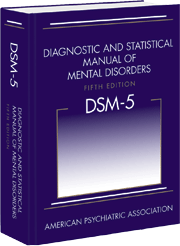
DSM-5_3DThe long awaited and controversial Diagnostic and Statistical Manual of Mental Disorders, version five (DSM-V) is slated to come out toward the end of this month.

The Diagnostic and Statistical Manual of Mental Disorders (DSM) is considered the bible of psychiatry. It is the guide we use in the mental health field to help us diagnose clients and this May, the newest version of the DSM, version five, is slated to be released, but not without much controversy.

The DSM is considered a research standard worldwide, yet, outside of the United States it is rarely used. Still, what is in the DSM is of international concern because trends in diagnosing in the United States (i.e., attention deficit disorder, autism) tend to spread worldwide especially in many European countries, China, Japan and Brazil.

Much of the criticism about the DSM comes from both the way illnesses are categorized and the ever expanding criteria for mental illness that basically makes everyday life issues a diagnosis.

Other  criticisms include weak scientific support and poor reliability in some of the DSM-V field trials, which leave some to believe that it will lose its role as the international standard for research journals.

One of the real dangers if the DSM-V is really that severely flawed is that all of the mental health field will also become tainted, with people not trusting those who are trusted to test, diagnose and help people in need.

With the DSM-V, we also put ourselves at more risk of mis-diagnosing, over-diagnosing and over-medicating individuals.

Some say that the changes to disorders such as Generalized Anxiety Disorder can include almost everyone, as well as a proposed new diagnoses called Somatic Symptom Disorder which will be diagnosed to any patient who has “excessive and disproportionate thoughts, feelings and behaviors” in relationship to an illness, which includes chronic pain and cancer. How much worry constitutes “excessive” worrying. Who wouldn’t be worried when they are dealing with a painful, chronic, potentially debilitating or life threatening illness?

Some believe that much of the flaws in the DSM period are because disorders are placed in discrete categories such as Bipolar Disorder and Schizophrenia, instead of “dimensionality” in which mental illnesses may overlap and people may be placed on one of several spectra such as the proposed Autistic Spectrum Disorders.

Most clients I see have a combination of symptoms, some which do not meet complete criteria for one specific diagnosis, but can meet several others and present differently at different periods, which is why I may see a client who has received three different diagnosis over the same number of years.

However, most in the mental health field prefer for mental disorders to continue to be categories as they already are which is one reason dimensionality won’t likely be introduced into the DSM anytime soon even in the face of growing evidence that disorders are more fluid and less rigid than previously thought.

It would take more research and funding into dimensionality for it to truly be accepted, but much of that research and funding is already put into confirming the categorization of mental disorders the way they already are.

Basically, people don’t really want change. Much of the mental health field, drug and insurance companies, like the rigidity of the DSM even though it is clear that it is failing many people.

Even patient groups and charities prefer the rigidity of the DSM because it highlights their disorder and keeps it visible. They do not want to see schizophrenia or bipolar disorder re-labeled into a spectrum just as Aspergers Disorder is slated to be dissolved into the autistic spectrum disorders.

On top of that health-insurance in the United States pay for treatment based on current DSM diagnosis. As a matter of fact, that is one of the most frustrating things about dealing with insurances.

In order to get paid for my services, they want a diagnosis almost immediately, usually after the first session or two of me meeting a client. Sometimes a DSM diagnosis is obvious, other times it is not and more time with the client is needed, but insurance companies won’t pay for that unless you diagnose them with something first. Insurance companies are probably the last ones who want to see the DSM categories dissolved.

According to Dr. Allen Francis, former chair of the DSM IV task force, the ten worse changes to the DSM-V are:

1) Disruptive Mood Dysregulation Disorder: DSM 5 will turn temper tantrums into a mental disorder- a puzzling decision based on the work of only one research group. We have no idea whatever how this untested new diagnosis will play out in real life practice settings, but my fear is that it will exacerbate, not relieve, the already excessive and inappropriate use of medication in young children. During the past two decades, child psychiatry has already provoked three fads- a tripling of Attention Deficit Disorder, a more than twenty-times increase in Autistic Disorder, and a forty-times increase in childhood Bipolar Disorder. The field should have felt chastened by this sorry track record and should engage itself now in the crucial task of educating practitioners and the public about the difficulty of accurately diagnosing children and the risks of over- medicating them. DSM 5 should not be adding a new disorder likely to result in a new fad and even more inappropriate medication use in vulnerable children.

2) Normal grief will become Major Depressive Disorder, thus medicalizing and trivializing our expectable and necessary emotional reactions to the loss of a loved one and substituting pills and superficial medical rituals for the deep consolations of family, friends, religion, and the resiliency that comes with time and the acceptance of the limitations of life.

3) The everyday forgetting characteristic of old age will now be misdiagnosed as Minor Neurocognitive Disorder, creating a huge false positive population of people who are not at special risk for dementia. Since there is no effective treatment for this ‘condition’ (or for dementia), the label provides absolutely no benefit (while creating great anxiety) even for those at true risk for later developing dementia. It is a dead loss for the many who will be mislabeled.

4) DSM 5 will likely trigger a fad of Adult Attention Deficit Disorder leading to widespread misuse of stimulant drugs for performance enhancement and recreation and contributing to the already large illegal secondary market in diverted prescription drugs.

5) Excessive eating 12 times in 3 months is no longer just a manifestation of gluttony and the easy availability of really great tasting food. DSM 5 has instead turned it into a psychiatric illness called Binge Eating Disorder.

6) The changes in the DSM 5 definition of Autism will result in lowered rates- 10% according to estimates by the DSM 5 work group, perhaps 50% according to outside research groups. This reduction can be seen as beneficial in the sense that the diagnosis of Autism will be more accurate and specific- but advocates understandably fear a disruption in needed school services. Here the DSM 5 problem is not so much a bad decision, but the misleading promises that it will have no impact on rates of disorder or of service delivery. School services should be tied more to educational need, less to a controversial psychiatric diagnosis created for clinical (not educational) purposes and whose rate is so sensitive to small changes in definition and assessment.

7) First time substance abusers will be lumped in definitionally in with hard core addicts despite their very different treatment needs and prognosis and the stigma this will cause.

8) DSM 5 has created a slippery slope by introducing the concept of Behavioral Addictions that eventually can spread to make a mental disorder of everything we like to do a lot. Watch out for careless overdiagnosis of internet and sex addiction and the development of lucrative treatment programs to exploit these new markets.

9) DSM 5 obscures the already fuzzy boundary been Generalized Anxiety Disorder and the worries of everyday life. Small changes in definition can create millions of anxious new ‘patients’ and expand the already widespread practice of inappropriately prescribing addicting anti-anxiety medications.

10) DSM 5 has opened the gate even further to the already existing problem of misdiagnosis of PTSD in forensic settings.

DSM 5 has dropped its pretension to being a paradigm shift in psychiatric diagnosis and instead (in a dramatic 180 degree turn) now makes the equally misleading claim that it is a conservative document that will have minimal impact on the rates of psychiatric diagnosis and in the consequent provision of inappropriate treatment. This is an untenable claim that DSM 5 cannot possibly support because, for completely unfathomable reasons, it never took the simple and inexpensive step of actually studying the impact of DSM on rates in real world settings.

Even with much of it’s flaws and criticisms, the DSM-V is likely to be the best guide for diagnosing mental disorders that we have had thus far. We can only hope that with further research and funding, the next revision of the DSM will be better and more forward thinking.

My Journey To Becoming A Therapist

couch_wide-eb7410d70ac8d556c8331f723e49c918ec26f2dd-s6-c10“What made you want to become a therapist?” That’s one of the most frequent questions I get asked by adults, many who marvel at me as if the ability to sit with, empathize, listen to and accept someone just as they are is some mystical superpower bestowed upon a select few.

Many follow that question by saying that they wouldn’t be able to deal with talking with “crazy people” or emotionally disturbed children all day without going crazy themselves, even saying that they can’t  deal with their own children, friends or family members when they are angry, sad or being irrational.

There was a time when I thought that counseling was something any and everyone could do, but now I know that not everyone can or should be a therapist. I’ve met some very bad therapists, people who may have had the education and credentials to counsel people, but definitely didn’t have the heart, patience or personality that is just as important if not more so.

Thankfully, most of these counselors learned pretty quickly that sitting down and helping someone unravel the complexities of their lives weren’t for them and ended up either getting out of the helping profession all together or moved to a part of the field that was less people oriented, such as working for insurance companies or becoming program directors.

I’ve witnessed teachers, administrators and other professional adults with good intentions do some very bad counseling. Some even made me cringe at either their bad advice, judgmental attitudes or total lack of empathy and I honestly was very thankful and relieved that these individuals weren’t officially counselors.

Being a therapist pretty much comes natural to me. Growing up I was always a very intuitive, carrying and empathetic person. I was always in touch with my feelings and would spend ours alone just trying to figure out why I felt a certain way. That curiosity soon lead to wandering why other people felt certain ways and why they did or didn’t do certain things. People watching became one of my favorite past-times.

In high school I was the person that girls would call and talk to about their problems with their parents, friends or boyfriends. I enjoyed helping them figure out and solve their problems  just as I enjoyed sitting in deep reflection about my own. I was probably one of the only boys in my high school that keep a journal and read self-help books.

Still, at that time I wasn’t even thinking about becoming a counselor. At that time I was interested in becoming a writer, an artist, a dentist or a meteorologist.

In college I decided I wanted to lean towards becoming a writer or an English teacher. I enjoyed writing just as I do today and it was writing that lead me to psychology. I was always interested in making my characters real and multi-dimensional which lead me to reading books on character development and eventually personalities and personality disorders.

There I found my love for psychology.

Soon I started taking every psychology course I could because I found it interested, but even more so because it helped with my writing. This is where I came in contact with Dr. Skinner who was not only my favorite psychology professor, but also became one of my first and most important mentor. He was always encouraging me to further my education in psychology which is one of the main reasons I decided to go on to graduate school.

In graduate school I initially was going to become a guidance counselor because I wanted to work with teenagers, but after taking all the courses required for guidance counseling, I still felt a hunger to learn more about psychology and counseling in general and so I transferred to the counseling and psychology track which was a lot of hard work when it came to reading, writing papers and giving presentations almost constantly.

It was learning the stuff I loved which is why I maintained a 4.0 throughout graduate school while working as a substitute teacher.

It was in graduate school that I started doing official counseling, and I was terrified!  To graduate from the program you had to do a 1,000 hour internship, not with friends or people I already knew, but complete strangers. To make it worst, I knew that I never wanted to be a substance abuse counselor and yet, my internship was at an inpatient substance abuse facility. I was determined to hate it.

I grew up in an inner-city neighborhood. I grew up around drug addicts. I already had my prejudices about people who used drugs and didn’t want to have to deal with them more than I already had growing up.

My dad also had struggled with substance addiction pretty much my whole life. He had been in and out of numerous treatment facilities and I had decided that substance abuse counseling just didn’t work. I tried my hardest to get my internship site changed, but couldn’t.

By the end of my 1,000 hour internship filled with individual, group and family counseling, I had a new respect for those who struggle with addictions and their families. I met people who had been trying to get sober since the 1970s! I met a popular high school football coach who gave up everything, his wife, kids and his prized job for alcohol.

I met women, mothers and daughters, so addicted to drugs and alcohol that their families had them committed to treatment and they were some of the sweetest women you could ever meet, who struggled everyday to control their cravings and stay clean.

Sure it was hard work, sometimes frustrating, disappointing and hard breaking (relapse is a b*tch), but it helped me deal with one of my own demons… it helped me understand my father and his battle with addiction so much better. It allowed me to forgive him.

After graduating I moved on from addiction counseling, perhaps it was still too close to home, and went to work in a psychiatric hospital. I always wanted to work with the severely mentally ill. dsmiv-c317a8bc457aaab1c0fb6b1a1de2b813d655dd09-s6-c10
In the Diagnostic and Statistic Manual of Mental Disorders (DSM) taught to us in school, I had learned so much about schizophrenia, bipolar disorder and other conditions that are rarely seen, yet I wanted to experience them face to face.

I spent three years working overnight in the psychiatric hospital giving psychological evaluations and crisis counseling to some of the most fascinating people ever.

I’ll never forget talking to a rather lucid schizophrenic woman who was having visual hallucinations. She gave me the best explanation of visual hallucinations ever, better than any professor or textbook I had ever read.

I remember trying to calm down a paranoid schizophrenic woman who was shaking like a leaf because she believed a killer was locked in the hospital with us and was specifically trying to kill her.

And I remember giving an evaluation to a tomato red faced woman (all the blood vessels in her face had broken) who had just been released from the hospital after trying to hang herself after finding out her husband was cheating on her.

So many experiences came from my time there, but I knew I was missing out on truly developing my counseling skills. One of my goals was to become a licensed mental health counselor, which is a whole lot of extra work after graduate school and I believed to be a great therapist, I had to know how to not only assess, diagnose and do crisis counseling, but also how to do more traditional counseling with clients who had more everyday type problem.

I still longed to work with children as well so I left the hospital and started working at an inner city high school, focusing mainly on anger management and substance abuse, but soon my job description expanded to include pretty much any and everything that stood in a child’s way of being able to concentrate and focus on their school work.

This is where I learned to work with defiant teens, broken families, damaged teens and teens who just needed someone to guide, care for and encourage them. This is where I saw our future, both promising and disheartening.

While here I also attained my goal of becoming a licensed mental health counselor and continue to learn every single day.

One of the most important things I learned is self-care and to take breaks for myself. Carrying the weight of so many other peoples problems can sneak up on you and break you down before you know it. Sometimes when people know you are a counselor, they will purposely or inadvertently dump their problems on you and that includes family and friends. It becomes important to take the counseling hat off sometimes and if that means going and sitting some place alone, then that’s what I will do.

Being a counselor/therapist is a very rewarding career, but it is probably one of the most mentally and emotionally draining careers I can think of. I enjoy the skills I have developed to analyze people, to read body languages and to be able to already have some ideal what’s going on with a person before he or she even says a word, but sometimes it’s hard to turn that off which sometimes impact my personal life.

One minute a friend will be asking me for advice or wanting to talk to me about a problem, but they don’t want me to “counsel” them. Then the next minute when I make a statement, they will stay “get out of my head” or “stop analyzing me”.

Sometimes I am more comfortable when I am in the counseling role and I will find myself retreating to that mode whenever I am uncomfortable or meeting someone new… not always a good thing. I realize it’s a defense mechanism I use where I limit the amount of information a person knows about me while I gain tons of information about them. That isn’t really fair, but I do it all the time and most people are so happy to talk about themselves that they never call me out on or even notice it.

Lastly, another thing I’ve learned is that being authentic with someone… being present with them and actively listening does miracles. There’s been times when I listened to someone and was present with them, but had no real ideal what to do or say, and after our session they were so grateful to me for listening to and helping them. It’s amazing. Sometimes I didn’t even say a word and yet they would be so grateful. That’s why I stress so much on listening, rather than talking in this blog. I believe that listening sometimes solves more problems than talking, lecturing or berating someone.
Childhood Abuse Linked To Asthma And Obesity In African American Women

Screenshot_2013-03-22-01-52-10-1According to research done at the University School of Medicine and Boston University’s Slone Epidemiology Center, Black women who have been physically and/or sexually abused during childhood and adolescence are more likely to become obese in adulthood as well as are more likely to later go on to develop asthma.

The study appeared in the journal Pediatrics and was based on a longitudinal Black Women’s Health Study which followed a large number of African American women since 1995.

What the study suggests is what many of us already know and that is that experiences during childhood may have long-term affects on our emotional and physical health.

“Abuse during childhood may adversely shape health behaviors and coping strategies, which could lead to greater weight gain in later life,”  says Renee Boynton-Jarrett, MD, who is the lead investigator in the study as well as a pediatric primary care physician at Boston Medical Center.

She goes on to say that metabolic and hormonal disruptions can result from abuse and that childhood abuse could cause other health problems like asthma. “Ultimately, greater understanding of pathways between early life abuse and adult weight status may inform obesity prevention and treatment approaches.” Boynton-Jarrett continued.

The same study found that physical and/or sexual abuse could more than double the chances of African American women developing asthma later in life. According to the study, African American women who suffered abuse in childhood had an increase of about 20 percent of developing asthma.

What’s also interesting is that the link between physical abuse and asthma seems to be stronger than the link between sexual abuse and asthma.

According to Patricia Coogan, the lead author in the study stated,  “The results suggests that chronic stress contributed to asthma onset , even years later.”
I had a professor in graduate school who always said, “Whatever you don’t deal with mentally, you will deal with physically” and this seems to be a prime example.

Stress in childhood experienced from abuse causes physiological consequences. Imagine the amount of stress one experiences living in an abusive situation. That type of stress can have an impact on the body, especially the immune and respiratory system and development.

There are unfortunately high incidents of childhood abuse as well as an increase in the prevalence of asthma with an increase from 7.3 to 8.2 percent, or approximately from 20.3 million to 25.6 million people from 2001 to 2009. The populations that saw the greatest increase in asthma were children from low-income families and African-American children.

I find this study to be very interesting because as a counselor, before I ever read this study, I recognized a link between obesity and sexual abuse in African American teenage girls.

I noticed that a large portion of the obese African American teenage girls I worked with, reported being sexually abused in childhood and early adolescence. I found this to be astounding and the more obese African American teens I worked with, the more it continued to be true.

It got to a point where I could look at an obese African American teen, the way they carry themselves and predict with about a ninety percent  certainty that they had been sexually abused before they ever felt comfortable enough to divulge that information.

I started thinking that maybe obesity and overeating became a unconscious defense  mechanism they used to become less attractive to not only the person who had sexually abused them, but possibly potential abusers in the future. And of course, overeating in itself could have been a coping mechanism used to help self-sooth themselves from the pain of sexual abuse.

I found it fascinating and yet sad, but this new research appears to back up some of what I had been suspecting although they seem to take it from more of a physiological than psychological approach.

What’s also interesting is that in her book Young, Poor and Pregnant, Judith Musick saw a link between sexual abuse and teenage pregnancy, meaning that some young girls who were being sexually abused, consciously or unconsciously sought out to get pregnant in hopes that their pregnancy and having a baby would make them less appealing to their abuser.

It’s obvious that physical and sexual abuse in childhood can have devastating affects on a child’s mental and emotional health well into adulthood, but new research is pointing to physical and sexual abuse also having long lasting physiological affects, making it that much more important that we not only fight to put a end of child abuse, but that we also provide help to those who have been abused.

Many adults I’ve spoken to who have been abused as children think of themselves as being resilient, and to a certain degree they are, but they don’t see the potential ongoing damage the abuse they experienced ten, twenty, or thirty years ago still has on their lives today. They don’t see that their relationship problems stem from lack of trusting or being able to relate well to men, that their depression comes from years of childhood neglect or that their overeating could be a result of past sexual abuse.

So much so that many of them don’t even initially mention being abused early on, although it is one of the first questions I ask. They go on for session after session, week after week, talking about issues that have roots in their childhood abuse, but they don’t recognize that and it’s only when they bring up the abuse and we address it, that they can truly start to heal.