Bipolar Disorder: A Snap Shot Through A Clients’ Eyes

The other day I was privileged to work with a client who had been battling bipolar disorder for over 30 years. This remarkable woman, we’ll call her Jane, first started experiencing symptoms of bipolar disorder at the age of 17.

In high school Jane was popular and on her way to be the school valedictorian, and then suddenly she was struck with a deep, deep depression. She describes that depression as feeling like someone had taken a dark veil and wrapped it all around her. It was suffocating.

During this depression Jane slept and ate as much as possible, gaining a large amount of weight. Her father, whom she lived with and was very close to, had no idea how to handle this situation. Instead of getting her help, he let her wade through this depression which she eventually came out of and went on to graduate from high school despite having a very rough year.

Then she started college, and the other side of bipolar disorder showed up, mania. She was extremely hyper, unfocused, partying all the time, exhausting her friends and boyfriend who eventually broke up with her and she quickly failed out of college.

Her father, still confused about what was going on with his daughter and maybe in denial or frustration, sent her to live with relatives on the other side of the country, telling her to get herself together.

By the time Jane was relocated with other family members, the depression was back and so was the binging and the weight gain. Jane reported that she slept as much as possible to try to avoid the intensely deep depression.

The mania and depressive episodes continued and eventually Jane left her family, ended up living on the street abusing drugs and alcohol like so many people who have a mental illness, but feel misunderstood do.

Eventually she was arrested and later hospitalized where she was diagnosed with bipolar disorder and put on Lithium, which she still takes to this day.

After she got treatment for her disorder, Jane was able to be her true self again. As she describes it, “Lithium allows me to be me”. She became fully functioning, got married, had children and obtained a job making six figures.

However, eventually her husband and her started having marital problems and she felt as if she had lost the bark she used to have when she wasn’t on lithium and was in one of her manic states. She felt as if the lithium was dulling her ability to stand up for herself so she stopped taking it.

In a short matter of time she fell back into a manic state which caused her to drive halfway across the country where she was eventually hospitalized after she was found wandering the streets telling people she was Jesus and they should follow her.

She was hospitalized and put back on Lithium, but by then she had lost her husband. Now however, she knows that bipolar disorder is something that she is going to have to live with, deal with and respect her whole life.

Now she doesn’t have a six figure job, or a husband, but she has her life back and she goes around speaking to groups about bipolar disorder in hopes to help get rid of the stigma of mental illness through recognition and education about mental illness.

There is a lot of stigma that goes with mental illness which causes those who are affected with it to refuse to talk about it and get help, and family members and friends to live in denial, refusal or misunderstanding about it.

Jane is helping people talk about mental illness so that someone doesn’t have to go through the things she went through before finally getting help.

She is a remarkable and strong person like most people who battle a mental disorder are once given the tools and support they need.

Daniel Sommers: A Soldiers Losing Struggle With PTSD And Depression

istock_000011501105small-eda6b80f8b0e6fb04724b38c94926b4e798fe269-s6-c30***Warning… this post may contain language that can be a trigger for depressed and/or suicidal individuals***

Recently I read about and researched the suicide of Daniel Sommers, an Iraq war veteran who was diagnosed with post traumatic stress disorder (PTSD), Gulf War Syndrome, fibromyalgia, and other medical conditions after his service in the armed forces in 2007.

Last month he committed suicide and his suicide letter was posted across the internet by his family, hoping to draw attention to the poor treatment of veterans by the United States Office of Veteran Affairs (VA).

While Daniel Sommers sought treatment through a variety of modalities including music, medication, and traditional therapy, nothing was enough to alleviate the physical and mental pain he felt and ultimately he took his own life.

Before I even started researching for this post, I was already researching the increase in young veterans committing suicide and was preparing to write a post about that, but when I read Daniel Sommers suicide letter, I felt like it gave a chilling insight into the mind of someone struggling with PTSD and depression.

“My body has become nothing but a cage, a source of pain and constant problems. The illness I have has caused me pain that not even the strongest medicines could dull, and there is no cure,”  Daniel wrote in his final letter. Those words echo so much of what I hear when I have worked with people suffering from diseases such as fibromyalgia, lupus and even undiagnosed problems that they are told are all in their head.

“All day, every day a screaming agony in every nerve ending in my body. It is nothing short of torture. My mind is a wasteland, filled with visions of incredible horror, unceasing depression, and crippling anxiety.” 

It’s not often that we get to see the last words and thoughts of someone who feels like the only solution is suicide. Being able to read Daniel’s words and analyze them, not only gives us great insight into the way he was thinking, but it can potentially help us help others who are thinking about ending their lives.

I have a book called Psychotherapy with Suicidal People and it is filled with suicide letters from people who ended their lives,  including some famous individuals. At some points it was one of the most depressing books I have ever read, but the amount of insight these letters give to us trying to help others is invaluable.

While the military and other non-profit support groups have many resources aimed at helping veterans with PTSD, Daniel Sommers family feels like the military failed their son and is failing others who have and are currently serving our country.

In February, the VA released findings from a study that said that 22 veterans commit suicide everyday and that 325 committed suicide last year. Those numbers are astonishing. If we were losing 22 children to shootings everyday, something drastic would be done.

Those numbers tell me that things could be better when it comes to the way we deal with and treat veterans dealing with PTSD and depression and some changes are coming.

In August, President Obama signed an order to increase veterans access to mental health services and the VA hired 1,600 mental health professionals while also adding more telephone and online help for veterans. Help for veterans is better than it’s ever been, but it’s far from perfect and too many people like Daniel Sommers are falling through the cracks.

As much pain as Daniel Sommers was going through, suicide is never the answer and the bad thing about his suicide letter going viral is that others suffering from depression and mental anguish may see this as verification that suicide brings about peace, but suicide is a permanent solution to what are usually temporary problems.

If you would like to read  Daniel Sommers suicide letter just click on the link. I didn’t want to post it because it could serve as a trigger for those already suffering with suicidal ideations. This is definitely a tragedy, but just think, there are 22 tragedies like this occurring everyday with just our veterans alone, not to mention our civilian population where the Center for Disease Control estimates 105 people commit suicide everyday.

Setting Up A Coping Skills Toolbox

My Journal
My Journal

Today I read a sign that said Sometimes you’re the statue, sometimes you’re the pigeon. It served as a good reminder that not everyday will be a good day.

It’s helpful that in anticipation of those not so good days that we have a set of healthy coping skills easily at our disposal, a “toolbox” if you will.

What are coping skills?

Coping skills are basically behaviors that we have developed to deal with times of distress. Some of those behaviors are positive (i.e., exercising) while others are negative (i.e., smoking). Positive coping skills allow us to deal with life stressors in a healthy way while negative coping skills generally make us feel better temporarily, and then either make us feel worse or lead to bad consequences.

People in recovery have probably heard of a coping toolbox before, it’s something that we usually have them work on in anticipation of relapses, temptations and set backs. I am not just talking about recovery from drugs or alcohol, but recovery from a mental illness, codependency or whatever it is you are trying to overcome.

Even if you aren’t in any form of recovery, having a coping skills toolbox can prove to be an invaluable asset when you have to face those not so good days.

Naturally, we all have coping skills we have developed over the years. Some we are conscious of and some we are not. Many of our coping skills are unhealthy or  ineffective. People who use substances, cut themselves, etc., are all using coping skills that are unhealthy.

The trick is to develop healthy coping skills that we are conscious of so that we can use them when we are having a bad day or feel ourselves headed in that direction. People who have a toolbox that is filled with positive coping skills are better prepared to deal with life stressors.

Because each person is different, one persons coping skills may not work for everyone, but it is useful to try different healthy coping skills to see what does work for you and to put those into your “toolbox” so that you can have a collection of visual or written cues to help you when you are having one of those days where you feel more like the statue than the pigeon.

Positive coping skills are a great way to reduce anxiety and depression and bring back a sense of balance and peace during times of distress.

It’s good to think about and start putting together your toolbox when you are having a good day, before a stressful event happens when you still have the energy and creativity. It’s like putting together a hurricane survival kit (for those of us here in Florida), you don’t wait until a hurricane is here to put together a survival kit, you do it before a storm even develops so that when the hurricane is knocking on your door, your kit is already prepared.

Here are some of the coping skills in my toolbox:

  • Journaling– I love keeping a journal as a way to express my thoughts and feelings, especially when I have a difficult time figuring them out and when I feel like I can’t talk to anyone else about them.
  • Creative writing– sometimes it’s helpful for me to put some of the distress I am going through into fictional characters or situations that may mirror mine. It helps to sometimes work them out in a fictional setting before applying them to my real world or just to vent and play things out without the real risk of harm.
  • Drawing/sketching– art therapy is a great way to release tension or explose your thoughts and emotions. Sometimes I just take a scratch sheet of paper and sketch, nothing in particular, but it helps ease my mind.
  • Exercising– I love to workout, but when I am stressed, working out becomes therapeutic. Sometimes I think it is the only way I have remained sane for so long 🙂 .
  • Meditation– sometimes I just sit steal and don’t try to think, feel or solve anything. Amazingly, sometimes just sitting still and doing nothing for five minutes resolves multiple internal conflicts I was having.
  • Mindfulness– focusing on the here and now often takes away angst I am feeling about the past and future. Just allowing myself to be here and reminding myself that I am exactly where I am supposed to be, allows me to release built up tension.
  • Distraction– sometimes I allow myself to just “change the channel”, virtually taking a mental break from whatever is bothering me. I may play a video game, read a book, call a friend, anything and often that distraction is enough to either allow those bad feelings/thoughts to pass or to put them in better prospective.

This is definitely not a definitive list, it’s just some of the tools I use in my toolbox. I know other people have included music, knitting and yoga in their toolboxes. What are you going to put in your coping skills toolbox?

Change And Inertia: Embarking On A New Adventure

6a00d8341d537753ef00e55133a7c08833-800wiI hate change, which I know is probably strange for me to say because during my therapy sessions I do a lot of what is called change talk, which is talking about and encouraging change. I generally consider myself to be an agent of change as I guide my clients through the stages of change, but I myself have always had issues with change. I don’t like it.

Some people love change and I always admire those people. They love new adventures, they adapt quickly, and never seem to get stuck in a rut or dead end job. They seem to just be wired differently and indeed, the ease to which people accept or don’t accept change is a personality trait known as the Openness trait and some people are naturally more open than others to change.

My fear of change over the years has cost me a lot. It has kept me at jobs I should have moved on from for far too long and in relationships I should have left for far too long. It has also kept me from experiencing many pleasures and probably some pains and failures, otherwise known as learning experiences and opportunities to grow.

I, like a lot of people, like being comfortable, playing it safe, even when that inertia isn’t all that great and sometimes downright unpleasant. There’s a popular quote by a late, great female therapist, I couldn’t find it or her name, but it basically says that we prefer the familiar negative to the potential unfamiliar positive, except of course she said it more beautifully.

And this tends to be true, at least for me and the majority of my clients who struggle to make changes in their thinking and interpersonal lives because they are afraid of what the new change will bring, good or bad, but they know exactly what the old thinking and behavior will continue to bring them, both good and bad. This is one of many reasons people resist change.

This is why I think I was so successful at helping people make changes they found difficult to make, because I understood their ambivalence towards change, their desire to both want to change and not want to change at the same time because I’ve experienced it so many times myself, even in ways that bordered being neurotic.

It’s easier to stay the same. Inertia is much easier than movement, especially when that movement has to be sustained, yet inertia robs us of so many experiences, opportunity and growth. A fellow therapist recently old me that if you are comfortable, then you are not growing. You should always be challenging yourself.

It’s that comfort zone I try to push my clients out of because sometimes you have to become a little uncomfortable to truly grow and realize your full potential and the same applies to me.

Some of you who follow my blog may know that the grant that pays for me to serve the students at the inner-city school I work at is coming to an end this Friday. The school has been working really hard to find funding to keep me and they may be close to working something out, but I couldn’t count on that to come through so reluctantly I started looking for another job.

Well an opportunity came up for me to apply for a job as a supervisor at the mental hospital I used to work at fresh out of grad school as a supervisor over the crisis unit I used to work at. I loved working in the mental hospital, I enjoyed dealing with people in various stages of a crisis from emotional and mental break downs to substance withdrawals.

This opportunity would force me to grow, push me out of my comfort zone, pay better and definitely be an upward climb in my professional career, so I applied for the job and got the news Friday that I got it. I should be excited right? But remember, I don’t like change and I do love working at the inner-city school I currently work at even though I potentially won’t be there next school year anyway because of funding.

image
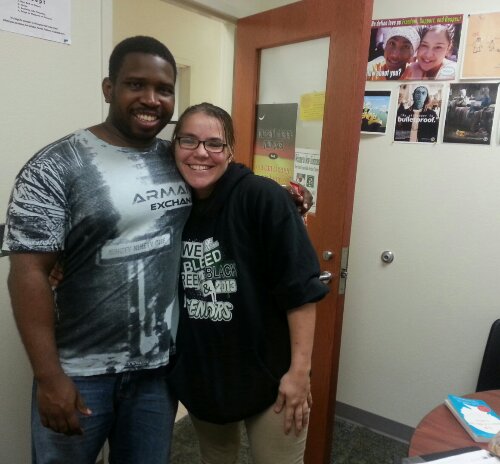
One of my first students and myself.

I love working with the teenagers I work with, helping mold young lives and by taking this job at the mental hospital, I would miss that although in my private practice I would still see a very small number of teenagers. Although I would be taking a pay cut to stay at the school, potentially not have a job this year or next year AND still be stagnant career wise, I seriously thought about turning down the supervisor job to stay where I was comfortable, in a place that would require no effort (inertia) although I know I would love doing my job (compared to the unknown level of satisfaction of a new job).

I’ve had similar opportunities twice in the past two years to make more money and move up professionally and both times I turned it down to stay comfortable. Of course I said I did it because the kids need me, and while I felt like that was true, I also know that a large reason I stayed was fear of change.

Now however, I am pushing myself into change just as I talk to my clients about pushing themselves out of their comfort zones.

It’s with a heavy heart that I took this new job, something I should be extremely happy I got because the chances seemed so slim when I first applied and went through two interviews. After all, I have no real supervisor experience, but I have experience working in a crisis unit and my love and dedication to the mental health field and those who suffer from mental illness is unparalleled.

And it’s with a heavier heart that I have to tell the school tomorrow that I will not be returning for another school year. It’s a tough decision and one I made ultimately not out of where the money was, or where I felt most comfortable, but where I needed to be for both professional and personal growth.

I am pretty sure it won’t feel as rewarding and life changing as working with the high school students I work with, but I think it will allow me to serve people in another way while learning more about myself and the mental health system altogether.

My passion will always be teens and adolescences, and I’ll continue to write a lot about issues that effect that population, but I am sure that naturally I’ll write more and more about issues and situations I encounter working in the mental hospital.

So while I am still anxious and uncomfortable  I’m pushing myself towards this change, trying to welcome it and all of the new possibilities that come along with change. After all, how can I promote change in others if I am unwilling to go through the uncomfortableness of change myself?

The Trayvon Martin Tragedy And Psychology, Part Three: Cultural Stereotypes

students_112210-thumb-640xauto-1605In part two of this three part post, we discussed how psychological research suggests that people who have a gun themselves are more likely to assume that other people also have guns, even when they don’t.

We have to wonder if this played a role the night when Mr. Zimmerman saw Trayvon Martin, who was wearing a hoodie and likely carrying the items he had (skittles and a can of ice tea) in the pockets of his hoodie.

Could, based on this research, Mr. Zimmerman think that the probability of Trayvon being armed was very likely which may have been another reason he was more willing to shoot?

In another research done by psychologist Joshua Correll, groups of college students were placed in a simulated situation where images were flashed across the screen, similar to the research mentioned above, instead these college students were asked to either shoot or not shoot the individuals that flashed across their screen depending on if they were armed or not, a situation known as Police Officer’s Dilemma. 

Some of the targets that flashed across the screen were holding an aluminum can, a wallet or a cell phone for instance. Participants who choose correctly to shoot an armed suspect were rewarded 10 ponts, if they correctly didn’t shoot an unarmed suspect they received 5 points. Shooting an unarmed person deducted 20 points and not shooting an armed suspect was deducted the most points, 40, because in reality that could mean paying the ultimate penalty of death.

As each target flashed across the screen, participants were asked to decide as quick as possible to shoot or not so shoot by pressing “shoot” or “don’t shoot” buttons. What the participants didn’t know was that some of the targets would be White and some Black.

Would the color of the suspects skin change the likelihood of shooting an unarmed suspect?

Over the course of four studies, researchers found what they termed shooter bias. Participants were quicker to correctly shoot an armed suspect if he was Black and to correctly not shoot an unarmed suspect if he was White. However, the alarming and sad discovery was that participants were consistently more likely to shoot an unarmed suspect if he was Black.

Why is this? Is this because those participants were racists who believed in the negative stereotypes of Black people being more dangerous, aggressive and likely to be armed? If this is the case, then participants who considered themselves to not be racist, to be fair and equal to all people, would have lower incidents in the research of shooting unarmed Black targets, but that wasn’t the case. Across the board, regardless of the level of racism, the same results could be predicted.

Outright levels of racism didn’t matter, but what did matter was- the participants’ level of awareness that there is prejudice towards Black people in American society, even if the participant adamantly did not support those stereotypes. 

What does that mean? It means that simply being aware that there are cultural stereotypes and prejudice towards a group, even if you personally do not believe and disagree with them, makes it more likely that in a split-second decision in an uncertain conditions, you are more likely to make a biased mistake such as shooting an unarmed, non-threatening person. This bias is likely to be depended on the person race, ethnicity, age, sex, etc.

This doesn’t mean that you are racist. I speak a lot in my group work about how we have all been brainwashed to various degrees by society and most of us have been brainwashed to believe that Black men are armed and dangerous. Even if you don’t believe this to be true, under uncertain conditions where you have to make a split- second decision, those subconscious thoughts come roaring into your consciousness and may make you respond irrationally.

We all live in a culture that embraces certain stereotypes and you don’t even have be aware of it, or think that it effects you for it to become imbedded into your cultural knowledge base. Even without you knowing, they will impact the way you interact, think and behave, sometimes in ways that are shocking.

In the article I wrote about some Black females wanting to have light skinned babies, I talked about the Clark Doll Test. This is another form of brainwashing where without even knowing it, little Black girls had been taught through social cues that Black= ugly and stupid while White= beautiful and smart. No one “taught” them this, it was ingrained into their cultural knowledge base by society.

By the way, when Black participants were given the same test, to shoot or not shoot, they were just as likely to shoot an unarmed Black person as White participants were. Cultural stereotypes affect all of us.

Cultural stereotypes can become automatically activated and influence our behavior, even without us knowing that is what is happening. Most of the participants in the study for instance would have probably been angry and disagree if it was suggested that the race of the target played a role in their decision to shoot or not to shoot, even when faced with the evidence.

Is Mr. Zimmerman a racist? Again, I can not say, but I do believe race played a role in this. However, I don’t think racism alone explains what happened and it is more complex. The fact that Mr. Zimmerman was carrying a gun of course played a role in this tragedy and definitely cultural stereotypes played a major role.

I think this tragedy definitely should open up conversation about many issues including the consequences we and our children have to deal with, growing up in a culturally stereotypical and racist society that affects all of us, even when we don’t realize it.

The Trayvon Martin Tragedy And Psychology, Part Two: Cognitive Bias And Confirmation Bias

Zimmerman Martin 104When we look at the Trayvon Martin case, we have to wonder what was going on in Mr. Zimmerman’s mind the night he spotted Trayvon Martin, an unfamiliar figure, walking through his neighborhood. Instead of looking at this as a race incident, I think it’s important that we take a look at what in psychology is called cognitive bias.

Cognitive bias is something that I find easier to understand than to actually explain, but Haselton, M. G., Nettle, D., & Andrews, P. W. in The evolution of cognitive bias (2005) explain cognitive bias as a pattern of deviation in judgment, whereby inferences of other people and situations may be drawn in an illogical fashion.

Basically, people create their own sense of reality (subjective social reality) based on their perceptions of objective information which influence how they respond and react to situations both mentally and physically. This cognitive bias however can be wrong and lead to poor judgement, wrong interpretations of a situation, perceptual distortions and irrational behavior/reactions.

Confirmation bias on the other hand is when we look for information that confirms what we already believe, even if other information that disconfirms it is also present. For instance, supporters of Mr. Zimmerman and Zimmerman himself will latch on to information that suggest Trayvon had a violence past, used marijuana or was involved in gang activity while Trayvon’s family and supporters will likely relish information that says Mr. Zimmerman was a racist, impulsive or quick to take the law into his own hands.

With little other information about either person, we are likely to come to some pretty strong conclusions based simply on our cognitive biases and confirmation biases alone.

Some cognitive biases are adaptive and help us make decisions faster, especially when a higher value is placed on quick action over accuracy. Others can be learned, generally subconsciously.

There are entire books written on cognitive biases, but the important part is that you have a basic understanding that people often think incorrectly and then act irrationally based on their misperceptions.

Late psychologist Ziva Kunda wrote in her article “The Case for Motivated Reasoning” that “people are more likely to arrive at those conclusions that they want to arrive at” unless they are motivated specifically to make accurate judgements and decisions.

For instance, there’s a study done by psychology professors at Notre Dame and Purdue University that showed that a person carrying a gun is more likely to “see guns in the hands of others”.

In the study, participants were given a toy gun or a foam ball. They were then flashed people across a computer screen holding either a toy gun, a cell phone or something else. The participants with the toy guns were more likely to say that the people on the screen were holding a gun, even when they were not.

In the Trayvon Martin situation this means that Mr. Zimmerman saw what he thought he saw based on his own experiences and mental frameworks. Mr. Zimmerman had stated on several occasions that there had been multiple break ins in his gated community and that “they always get away”. By “they” I am assuming he means burglars or other bad guys, not African Americans, but those who are looking for a racist spin will interpret “they” as meaning African American or black people.

Mr. Zimmerman was looking for Trayvon to be a criminal and thus he saw a criminal, although Trayvon was just walking back to his father’s house from the store and wasn’t involved in any criminal activity. As the neighborhood watchman, Mr. Zimmerman was likely looking for criminal and suspicious activity everywhere and thus was more likely to think someone was a criminal or suspicious even when they weren’t.

Now that Mr. Zimmerman believes he has spotted a criminal, he goes on to do some irrational things based on his cognitive bias that Trayvon is a criminal. He starts following Trayvon, calls the police and then continues to follow Trayvon so that he can give the police an accurate location to find this “criminal”.

Many people want to say that Mr. Zimmerman did what he did on that night because he is a racist, something I can’t say he is or isn’t, but you don’t have to be racist to be prejudice and you’ll be surprised to learn that most of us are prejudice to some extent.

Subconsciously we are more likely to be prejudice towards out-groups, which are people we psychologically do not identify with as part of our group. I discussed in a post I wrote about helping others how this same type of subconscious thinking makes it more likely for us to help those that we feel are similar to us in what is called similarity bias. 

Because Trayvon was of a different race, it made it more likely that subconsciously Mr. Zimmerman was even more suspicious of him. In the next post I’ll discuss how social stereotypes predispose most of us to have certain prejudices that then lead us to have different cognitive bias.

Although these subconscious forces are indeed powerful, there is a way we can control them to a degree through what is called “thinking safe” instead of “thinking quick”. When we think quick, we are likely to make inaccurate assumptions and if Mr. Zimmerman thought he had spotted a criminal prowling his neighborhood, he was most likely thinking “quick” and not “safe” and his cognitive biases and subconscious prejudices combined with that probably contributed a lot to the actions he took that night that left an unarmed teenager dead.

What I am getting to is that while race and prejudices probably played major factors into this tragedy, most of it likely came from subconscious psychological factors that were at play.

We will put all this together and wrap it up in part three of this discussion.

The Trayvon Martin Tragedy And Psychology, Part One: My Personal Thoughts And Experiences With Racial Profiling

trayvon_martin_dad1The Trayvon Martin trial began this week with jury selections that are proving to be difficult for multiple reasons.

The Trayvon Martin case hits home for me for many reasons, not just because I too am an African American, but because the small city this happened in, Sanford, Florida is a suburb of Orlando, the city I live in. As a matter of fact, one of the schools I was offered to transfer to is located in Sanford.

Another reason it hits home for me is because as an African American male I have faced racial profiling many times in my life, especially when I was a teenager.

When I was a young teen it was very common for me to be followed around in stores and I can remember at least twice when I was actually stopped and confronted by a store worker for “stealing” although I wasn’t. My friends and I used to have a joke that once we entered a store they would have a special code they would say over the intercom to alert them that black people were in the store.

When I was young I thought it was a necessary hassle, sometimes I even thought it was funny because the store clerks would try not to be obvious, but they were always obvious to me. I was, even at a young age always aware however that I was seen a a criminal and “guilty” even though I had committed no crimes.

As an older teen things got worse, but still, being a teenager I didn’t take it personal and even thought it was funny at times.

Driving my mother’s car, on a weekly basis I would get pulled over, sometimes searched, but always inconvenienced for absolutely no reason.

I remember my friends and I would go to Dennys and sometimes be there for an hour or longer before we were ever even asked what we wanted to order. At the time I didn’t think anything of it other than bad service, but when I got older, I learned about the discriminatory practices Dennys used in some locations to deter African American customers and have no doubt that is what was going on then, we just didn’t know it.

Being harassed by the police was so common that I started to feel like a criminal whenever I saw one, expecting them to stop and search me for no reason which sometimes they did.

In particularly I remember an incident in which I went to visit with some friends in a gated community and decided to take a walk around the block. Well I didn’t even get half way around the block before I was approached by security and asked what was I doing there. He stated that someone had called about a suspicious person in the neighborhood. I couldn’t help, but to think that the only thing that truly made me suspicious was my skin color, because unlike Trayvon Martin I wasn’t wearing a hoodie and it was daylight out.

The Trayvon Martin case hits so close to home because I, like millions of other black and brown men around our country can identify with his situation. I don’t want to go into detail here because I don’t know all the details, but what I do know is what we know from Mr. Zimmerman himself.

He saw Trayvon Martin and for whatever reason thought that he was up to no good. We know that Trayvon was doing nothing wrong, yet he was viewed as a criminal and guilty automatically, much like I have been multiple times in my life.

For this reason, I will write a bigger, more in-depth article behind some of the psychological reasons I believe this tragic incident happened.

As a young African American male, I took the harassment by store clerks and law enforcement as a necessary price I had to pay for being young and black. I didn’t take it personal, but as I got older and became a college educated adult with a professional job, on the rare occasions I felt harassed because of my skin color, I no longer found it funny or necessary, but extremely irritating and degrading.

About two years ago on my way to work, dressed in a shirt and tie I got pulled over by a police officer. I actually knew he was going to pull me over before he did it because it was just him and me on the road. I didn’t mind the stop because I knew I didn’t do anything wrong and after checking my license and verifying I had no warrants, instead of letting me go he asked me if I had any guns and drugs in the car and if I minded if he searched it.

I was shocked, largely because I had assumed that this type of harassment would stop when I got older and certainly once I went to college and became a professional, but it didn’t, it just became less frequent.

About four months ago I was pulled over by an undercover truck with four police officers, asking me again if I had drugs and guns. It was only when one of the officers recognized me that they eased up and immediately let me go. It was dark and if I had mistakenly took this undercover stop as a carjacking (which I initially was afraid it was) it could have ended tragically for me.

Just yesterday on Facebook, a friend of mine and a successful store manager wrote jokingly, “The first time not getting pulled over for being black I get 2 tickets. I think I prefer them holding me at gunpoint and searching for guns and drugs, it’s cheaper.”

The Trayvon Martin case resonates with me because it could have easily been me or one day, my son.

I think this unfortunate situation has a lot to teach us not just about race relations, but about the way we receive and perceive information through our minds based on preconceived notions which we will explore in my next post.

.

Absent Fathers Can Lead To Depression In Teenage Girls

0e1380145_istock000002757055mFather’s Day is coming up and I recently read a study out of the United Kingdom published in the journal Psychological Medicine that suggests that young girls who grow up without their fathers turn into depressed teenagers later in life.

It’s well known that depression tends to effect teenage girls much more than teenage boys and that trend stays the same throughout adulthood. New research is suggesting that when young girls  grow up without their fathers, the risk of depression increases with 23% of teenage girls showing signs of tiredness or sadness if they’re separated from their father before the age of five.

According to the study, it also makes them 50% more likely to develop other mental health problems compared to girls whose fathers remained in their lives.

Preschoolers are especially vulnerable with dealing with divorce and separation poorly because they generally do not have a support system of peers or family members.

I took a quick survey of five teenage girls I am working with who have been diagnosed with depression, anxiety, bipolar disorder, bulimia  and substance abuse and four out of five of them were abandoned by or separated from their father at an early age. Some through death, others through divorce or separation.

Many of the teenage girls I work with are suffering from “daddy issues” and are dealing with them in unhealthy ways. Some through self-hatred, others through drugs and alcohol or being extremely promiscuous and unstable in terms of dating and relationships.

Boys tend to handle absent fathers better according to the study, but I would like to suggest that they just express themselves differently and may not show signs of depression we typically look for. Instead boys may be angry, “troubled kids”, or become more withdrawn and reckless. I also think boys have more outlets to let out their frustrations through rough housing, sports and other physical activities.

Both older boys and girls tend to handle separation and divorce better with less instances of depression later in their teenage years, but working with teenagers I have no doubt that the effects of growing up without an attentive and active father are powerful and far reaching.

This is not to say that separation from their father at an early age definitely leads to depression in teenage girls. There are too many other factors such as economic  and social factors that also need to be taken into consideration. Also, girls tend to be more susceptible to personal negative events than boys which can lead to episodes of depression.

I think the take away from this research is not to stay in unhealthy or undesired relationships for the sake of the children because that can also have detrimental effects, but I think it suggests that we need to pay closer attention to young girls who have been separated from their fathers as parents and as those who work with children.

Fathers should stick around and be active in their daughters lives, even if the relationship with the mother has failed. A lot of time men think that they don’t have to be as involved with their daughters, but nothing could be further from the truth.

Mothers on the other hand shouldn’t gloss over the fact that their young girl is growing up without a father and should start looking for signs of emotional or behavioral stress or changes that may warrant attention such as individual, family or group counseling.

The most erratic and unstable young women I work with tend to be the ones who grew up without their fathers and I can only wonder that if they still had good relationships with an active and supportive father, if they wouldn’t be more stable and focused.

How The Mental Health System Is Failing Minorities

iStock_000009898060XSmallI’ve wrote a bit about how the mental health system is failing those who need it most and a lot of those people are usually poor and/or minorities.

Working in an inner-city area I’ve always been valued as a licensed mental health counselor able to diagnose and treat a wide array of mental issues and refer clients who needed more attention, testing or medication to people and places able to provide those services.

Sometimes I didn’t quite appreciate or understand the praises I got from other school administrators, faculty even clients and their families. To me I was just doing my job, but to them, at times I was seen as a hero.

It wasn’t until recently that I actually thought about this. Within the past year two crucial agencies pulled out of the school because of lack of funding. These two services provided mental health counseling to the students who needed it three days out of the week while I was there everyday. They were not licensed and generally dealt with less severe, but no less important issues.

Because these two agencies are no longer on campus, this year my case load exploded to way more then I could handle by myself, but I had no choice but to try to handle it the best I could which at times wasn’t always that great. I was overwhelmed, underpaid and under appreciated by the agency I work for, but very much appreciated by the school, students and families I served.

To make things worse, I may not be at the school after the end of this month because funding is being cut from my agency as well.

While to me it is ultra important that these kids and families receive my services, like I wrote in my previous post, it boils down to money over actual quality of care.

It was then that I started realizing that there weren’t many options for those in inner-city communities who need mental health services, largely because poor and minority people with mental illnesses are more neglected and inner-city communities receive less funding which is one reason the two agencies I mentioned above pulled out of the school I work at, they lost some of their funding.

A lot of the funding that comes for mental health servies in inner-city communities is based on grants, and grants come and go very easily, often doing great work in a community for a couple of years and then leaving them without any support.

With that being said, it’s really hard for the kids I work with and their parents to receive quality mental health services in their community.

Many of them end up getting services through the jail or prison or are involved with child protective services which is where many of them end up because they have issues such as uncontrollable behavior that haven’t been addressed, but this creates a host of other problems due to the stigma that comes with it and because it eternalizes a racial stereotype that this is where Black people end up.

However, once these people are no longer incarcerated or receiving services through child protection services, without support, most will regress back to their previous mental states and behaviors. Only about 33% of African Americans suffering from a mental illness are retrieving proper treatment.

Because of this neglect, there isn’t much research on treating minorities with mental disorders such as depression, schizophrenia, bipolar disorder, substance abuse and others conditions.

Yes, it is true that for the most part, there is little to no difference in these disorders across races or socio-economic statuses, but there are cultural and social differences that play major roles in properly treating these disorders.

African Americans have been ignored for decades when it comes to mental health. Before the 1960s, it was believed that African Americans could not get bipolar disorder or depression for example. It wasn’t until 2001 when former Surgeon General Dr. David Satcher, who is African American, released Culture, Race and Ethnicity. A Supplement to Mental Health: A Report of the Surgeon General, which brought the disparities into national light.

Working with minorities from African Americans, Haitians, Latinos and Asians, I know that culture plays a large role in who and how individuals receive mental health services.

Some cultures are very private and trying to get the whole family together for a session can be almost impossible, while others, especially African Americans, seem to be more suspicious of the mental health system in general and are more likely to stop treatment early without any follow up and to not follow through on medication recommendations.

Because of this distrust, many will turn to a friend, then their pastor, and then their general doctor before finally turning to a mental health professional for help with a disorder.

Because of all these issues, I see why my role within the school I work with is seen as so important. I am able to bond with the students and give them and their families services that they may not otherwise receive.

On top of that, I think I am helping to remove some of the stigma associated with getting help for a mental health problem.

Many of my minority clients, when I first meet with them automatically tell me that they are not going to take any medication or go to the mental hospital, as if that’s all those who work in the mental health field do, medicate people or hospitalize them.

Through getting to know me, they realize that I just want to help them get through whatever is bothering them and I have no plot to medicate them or put them in a mental hospital unless it is absolutely necessary.

One of the students told me last week when I told her I wasn’t sure if I would be back next school year that, “If you are not here, there will be more kids going crazy, more people fighting and using drugs”. That thought saddened me. I even thought about volunteering some of my time to the students if at all possible.

I am not a hero, I am really just doing my job and doing what I feel called to do, but I see that without my services being conveniently offered on campus where students and their families can easily access them, there isn’t much else around. Unlike in more oppulent areas, there aren’t any private facilities with modern technology. There’s nothing.

So yes, the mental health system is failing most people who truly need it, especially minorities and poor people who are largely ignored and underserved including teenagers just trying to survive in a violent, crime ridden neighborhood at an inner-city school that serves as their haven away from their broken homes and communities.