Working Around Your Abyss

SONY DSCI’m always amazed at the lengths some people will go through to hide their pain. All of us have pain, disappointments, regrets, wounds, and parts of us we wish we could hide forever, but many times those very issues are the things we need to address in order to move on and live truly fulfilled and happy lives.

The other night I was watching Beyond Scared Straight on A&E and there was a kid on there whose father committed suicide when he was younger and it looked like the kid had never really talked to anyone about it or dealt with it in any sort of healthy way. Instead he turned to drugs, violence and other petty criminal behaviors as a way of acting out and dealing with what I believe must be anger towards his dad coupled with immense depression.

Most people would look at this kid and see a juvenile delinquent, but all I saw was a kid crying out for someone to see past the walls he had erected around his pain and help him navigate his way around it.

This young kid wasn’t unlike many of the high school kids I dealt with that teachers thought were just bad apples, but they were really acting out because of the pain they were holding on to, such as coming from poverty stricken, sometimes violent and unstable broken homes. Especially the boys who would hold on to their pain so tight, not wanting to show any weaknesses, and yet the pain was literally destroying them by causing them to constantly get in their own way by fighting, failing out of school or getting involved in illegal activities that were sure to lead to incarceration.

We all have stuff. We all have issues. That is something I say all the time when people open up to me, no matter if they are clients or friends. I always encourage talking about those pains because I believe that talking about them, even just a little bit, helps ease some of the tension, stigma, shame, and fear people attach to their pain.

While some people try drastic measures to consciously or unconsciously hide from, ignore, deny or cover up their pain (sex, drugs, alcohol, cutting, eating disorders, continued bad relationships, etc.), some people are so absorbed in their pain that can’t even enjoy moments of happiness when they happen. They can’t see anything except for their pain. They live in constant depression, anxiety, suspicion, and pessimism.

It may be something that happened a long time ago, yet they are never living in the moment, they are constantly living in the past and their pain. They are constantly unconsciously telling themselves stories which for the most part are untrue. Stories about themselves, their pain and their lives. Stories that hold them hostage to turmoil and they will hold on to those stories with a death grip even in the face of evidence that their stories are at least partially untrue.

The stories we tell ourselves include things such as, “My dad left because I was a bad kid”, or “My husband cheated because I wasn’t enough for him” and “I fail at everything I try”. The list goes on and on, but you can imagine how someone who is telling themselves these stories will live their lives in the present and future if they continue to believe these stories about themselves.

They will hold on to those stories, sometimes because it is the only story that they know and it’s much easier to believe in the story that you know than to try to create a better story where there may be unexpected surprises even if some of the surprises include very pleasant ones.

One of my favorite books is entitled The Inner Voice of Love: A Journey Through Anguish To Freedom by Henri Nouwen. It was given to me as a gift several years ago and I have since given it away, brought it again and given it away again no less than eight times.

The first passage in that book is called Work Around Your Abyss and it says:

There is a deep hole in your being, like an abyss. You
will never succeed in filling that hole, because your
needs are inexhaustible. You have to work around it
so that gradually the abyss closes.
Since the hole is so enormous and your anguish
so deep, you will always be tempted to flee from it.
There are two extremes to avoid: being completely
absorbed in your pain and being distracted by so
many things that you stay far away from the wound
you want to heal.

When I first read that passage about six years ago, I almost cried because I felt like it was talking directly to me. I was holding on to a lot of pain and not doing anything about it. Pain about my fathers death, pain about our relationship, pain about the romantic relationship I was in and fear of not being completely loved and fear of failure.

Holding on to and not addressing those pains was leading to anxiety, depression, low self-esteem and agitation. It was until I read this passage that I started to address and work around my abyss which slowly, but surely started to close and this passage is probably the #1 reason I have shared this book so many times with people who have shared some of their pain with me.

All of us have issues, or what I like to call “stuff”, but it doesn’t have to define us and we don’t have to wear it like a scarlet letter nor pretend like it’s not there. We define ourselves and our situations, our situations do not define us. Let’s all make a commitment to start working around our abyss so that we can start living fully and completely, the way we were all meant to live.

How The Mental Health System Is Failing Minorities

iStock_000009898060XSmallI’ve wrote a bit about how the mental health system is failing those who need it most and a lot of those people are usually poor and/or minorities.

Working in an inner-city area I’ve always been valued as a licensed mental health counselor able to diagnose and treat a wide array of mental issues and refer clients who needed more attention, testing or medication to people and places able to provide those services.

Sometimes I didn’t quite appreciate or understand the praises I got from other school administrators, faculty even clients and their families. To me I was just doing my job, but to them, at times I was seen as a hero.

It wasn’t until recently that I actually thought about this. Within the past year two crucial agencies pulled out of the school because of lack of funding. These two services provided mental health counseling to the students who needed it three days out of the week while I was there everyday. They were not licensed and generally dealt with less severe, but no less important issues.

Because these two agencies are no longer on campus, this year my case load exploded to way more then I could handle by myself, but I had no choice but to try to handle it the best I could which at times wasn’t always that great. I was overwhelmed, underpaid and under appreciated by the agency I work for, but very much appreciated by the school, students and families I served.

To make things worse, I may not be at the school after the end of this month because funding is being cut from my agency as well.

While to me it is ultra important that these kids and families receive my services, like I wrote in my previous post, it boils down to money over actual quality of care.

It was then that I started realizing that there weren’t many options for those in inner-city communities who need mental health services, largely because poor and minority people with mental illnesses are more neglected and inner-city communities receive less funding which is one reason the two agencies I mentioned above pulled out of the school I work at, they lost some of their funding.

A lot of the funding that comes for mental health servies in inner-city communities is based on grants, and grants come and go very easily, often doing great work in a community for a couple of years and then leaving them without any support.

With that being said, it’s really hard for the kids I work with and their parents to receive quality mental health services in their community.

Many of them end up getting services through the jail or prison or are involved with child protective services which is where many of them end up because they have issues such as uncontrollable behavior that haven’t been addressed, but this creates a host of other problems due to the stigma that comes with it and because it eternalizes a racial stereotype that this is where Black people end up.

However, once these people are no longer incarcerated or receiving services through child protection services, without support, most will regress back to their previous mental states and behaviors. Only about 33% of African Americans suffering from a mental illness are retrieving proper treatment.

Because of this neglect, there isn’t much research on treating minorities with mental disorders such as depression, schizophrenia, bipolar disorder, substance abuse and others conditions.

Yes, it is true that for the most part, there is little to no difference in these disorders across races or socio-economic statuses, but there are cultural and social differences that play major roles in properly treating these disorders.

African Americans have been ignored for decades when it comes to mental health. Before the 1960s, it was believed that African Americans could not get bipolar disorder or depression for example. It wasn’t until 2001 when former Surgeon General Dr. David Satcher, who is African American, released Culture, Race and Ethnicity. A Supplement to Mental Health: A Report of the Surgeon General, which brought the disparities into national light.

Working with minorities from African Americans, Haitians, Latinos and Asians, I know that culture plays a large role in who and how individuals receive mental health services.

Some cultures are very private and trying to get the whole family together for a session can be almost impossible, while others, especially African Americans, seem to be more suspicious of the mental health system in general and are more likely to stop treatment early without any follow up and to not follow through on medication recommendations.

Because of this distrust, many will turn to a friend, then their pastor, and then their general doctor before finally turning to a mental health professional for help with a disorder.

Because of all these issues, I see why my role within the school I work with is seen as so important. I am able to bond with the students and give them and their families services that they may not otherwise receive.

On top of that, I think I am helping to remove some of the stigma associated with getting help for a mental health problem.

Many of my minority clients, when I first meet with them automatically tell me that they are not going to take any medication or go to the mental hospital, as if that’s all those who work in the mental health field do, medicate people or hospitalize them.

Through getting to know me, they realize that I just want to help them get through whatever is bothering them and I have no plot to medicate them or put them in a mental hospital unless it is absolutely necessary.

One of the students told me last week when I told her I wasn’t sure if I would be back next school year that, “If you are not here, there will be more kids going crazy, more people fighting and using drugs”. That thought saddened me. I even thought about volunteering some of my time to the students if at all possible.

I am not a hero, I am really just doing my job and doing what I feel called to do, but I see that without my services being conveniently offered on campus where students and their families can easily access them, there isn’t much else around. Unlike in more oppulent areas, there aren’t any private facilities with modern technology. There’s nothing.

So yes, the mental health system is failing most people who truly need it, especially minorities and poor people who are largely ignored and underserved including teenagers just trying to survive in a violent, crime ridden neighborhood at an inner-city school that serves as their haven away from their broken homes and communities.

One Teens Attempted Suicide

Today I got one of those out of the blue phone calls that I dread. I was out of the office preparing files for an upcoming audit when I got an email from one of the teachers at the school I work at asking me to call her as soon as possible.

There’s always a lot going on at the school, but I assumed she wanted to ask me for advice with dealing with one of her students or to refer a student to me for counseling. I called her and she informed me that one of my students was in the hospital in critical condition after attempting suicide the night before.

I almost cried. I know that’s not the professional way I was supposed to feel, but I am human and have passion for my clients. Sometimes too much, but that feeling felt appropriate. I have never (fingers crossed) had a client actually commit suicide, but I know it’s always a possiblity. I’ve done crisis counseling at enough schools after a teen has committed suicide to know that it happens all too often. As a matter of fact, 3 weeks ago a student at a high school not too far from the one I work at killed herself.

It’s not that this is the first client of mine to attempt suicide, but this is probably the first client of mine to make a serious suicide attempt. I don’t want to underplay any suicide attempt, but I have had many clients who have made superficial lacerations to their wrists or took three ibuprofens in a “suicide attempt”. Most never needed to go to a medical hospital for medical attention.

Sure, I had to have them sent to the psychiatric hospital because they were having suicidal thoughts and any attempt has to be taken seriously, but it never shocked me because I knew that while they were hurting emotionally and psychologically, they didn’t want to die. They wanted help, they wanted people to see and know that they were hurting, but they didn’t really want to die. The fear in that though is that they could accidentally kill themselves.

This situation was different for a number of reasons.

1) I was very close to this client. I had been working with this particular client for almost two years helping him get through depression, grief and anxiety. I actually tried to become more of his mentor than his counselor because that’s what I felt like he needed most as a young man approaching adult hood.
2) A few months ago this particular client came to me and told me that they were seriously thinking about ending their life. I had him admitted to the psychiatric hospital where he was prescribed medication for anxiety and depression. I was surprised and scared that he didn’t come to me this time before he tried to take his life.
3) He had a lot to look forward to. He was graduating after almost not qualifying to graduate. I had just giving him a graduation card saying that I was excited for him about his future.
4) And lastly, I had just saw this client the day before and he was his normal, apathetic self. I saw no warning signs that less than 24 hours later he would take 3 months worth of medication all at once.
5) While all suicidal talk, gestures and attempts have to be taken seriously, from personal experience, the teens that actually kill themselves do so with little real warning. Some may tell all their friends that they love them, or apologize for past wrongs, but from the crisis counseling I’ve done at different schools after a student has committed suicide, there is rarely any apparent warning signs yet in hindsight, grieving students, faculty and parents usually see subtle signs that they missed.

His mother found him in his room, unresponsive and called 911. He was rushed to the hospital where a host of procedures were done to save his life. When I went to the hospital to see him he was still unresponsive, a result of all the medication he had taken, but the doctor was pretty sure he would make a full recovery… physically.

The fear is, when he finally comes to, is he going to be happy that he’s still alive, or disappointed that he failed to end his life?

That’s why I want to be there for him. I stayed with him in the hospital today for as long as I could, but the hospital staff that was in charge of sitting with him around the clock because he is on suicide watch, told me that it would be at least another day or two before they expected him to start coming around.

I don’t feel like I failed as a counselor. That’s one of the first questions I asked myself. I think that the reason it bothers me so much is because he is my client and I feel a sense of responsibility for him, although I know I can’t be responsible for the decisions he makes.

Looking at him laying in the hospital today was depressing. At times he looked dead except for the frequent rapid eye movement visible through his closed lids. I just hope that when he comes to that he realizes that he is alive for a purpose and rejoices in attempting to discover what that purpose is. I’ll definitely be here to help him anyway I can.

Counseling Minors and Confidentiality

Little-boy-shhhh-cropped-300x297Confidentiality is a crucial part of counseling. Clients have to believe that they can tell me practically anything and it won’t be repeated to anyone, including their parents.

All of my clients know that everything they tell me stays  between us except:

  • If they tell me they plan on killing themselves or someone else
  • If they tell me that are being abused
  • If I am court ordered to release information, and because I work in a school
  • If they have drugs or weapons on campus.

Also, because I work primarily with juveniles, I leave a little wiggle room by saying I will also report anything “life threatening” which may not include marijuana or alcohol use, but may include intravenous drug use or meeting adults online.

Even with these rules of confidentiality, teens will still inevitably tell me things that need to be reported to their parents, the school, law enforcement or child protective services.

More often than not, the child already knows this before they tell me so they aren’t usually upset when I have to make that phone call.

The problem generally comes from parents, who may not understand confidentiality. They think that their child is in counseling and as the counselor, I should tell them any and everything their child is doing and can get testy when I have to explain to them that confidentiality doesn’t work that way and that it’s actually illegal for me to tell them any information that doesn’t fall under the exceptions above, without their child’s permission.

I understand these rules and have worked within the confines of them for many years, even when I am hearing information that I wish I could tell parents. Information I actually knew would help the situation, if the parents knew.

For instance, last year a young lady was devastated when she went to a friend’s party and got raped by him and four guys she didn’t know. She was in tears when she confided in me and after calming her down, I practically begged for her to give me the name of the guys, some who went to the same school as her, or to report it to law enforcement.I gently repeated this request each session as we processed the trauma.

I offered to go with her to make the report, but she was adamant about not telling me any identifying information. She told me that she was scared that they would come after her if she told. No amount of me trying to convince her worked and at the end of it all, I had to allow her to make that decision she will have to live with for the rest of her life.

As much as I wanted to report that crime to law enforcement and her parents, I couldn’t. I had no identifying information, she wasn’t abused by a caregiver or someone in authority and she wasn’t a danger to herself or others so my hands were tied. All I could do was try to help her get through the emotional and psychology pain she was feeling. She went through a period of deep depression and eventually transferred schools.

I have had teens who have had abortions and miscarriages without their parents ever knowing they were pregnant. Kids who have battled substance and alcohol abuse right under their parents noses.

I always strongly encourage my teenage clients to involve their parents in their treatment though family counseling, but most teenagers are hesitant to let their parents know the things they do when they are not looking, or think that their parents will just be angry, judgmental or not listen if they do open up.

I usually only do a couple of family sessions a month and those usually happen after emergencies such as suicidal thoughts, severe panic attacks that require medical attention or another extreme circumstance  that causes the parents to be concerned.

That’s usually when, with the child’s permission, I feel like I can finally truly help them without restraints. Trying to help a child solve a problem that need parental involvement, when they don’t want the parent to be involved is truly handicapping.

However, this is usually also the time when parents get upset that I knew about the abortion, or the drug use, or the date rape that they didn’t know about, months sometimes even years before.

I let them know about the confidentiality regulations set by the Health Insurance Portability and Accountability Act (HIPPA) that prevented me from giving them that information, even when it was valuable information about their own child.

Most parents calm down once they realize that without the confidentiality between their child and myself, it would have been unlikely that their child would have told any trusted adult and received at the minimal, mental and emotional support as well as guidance and encouragement.

Some minors want help or at least to talk about issues in their lives that are concerning them, but will only do so if they know that their parents will not be notified. Not all parents are supportive and some parents could use the information to further cause damage to their child, knowingly or not.

Take for instance a girl I know who is scared of her father who has a past history of physical abuse against her. He’s told her that if he ever finds out she is having sex he will kick her out on the streets. Yet, she is having sex and thinks she may be pregnant. Should I risk her losing her housing in order to tell her father that she may be pregnant?

I believe breaching confidentiality, while it will give parents more information about their child, it is less likely to truly make a difference if that child just learns to hide their problem or not admit or talk about their problem anymore, resulting in them getting less help.

I definitely understand when parents are frustrated with confidentiality when it comes to their children, which is why I always encourage open communication and family therapy, but most kids I deal with would never want their parents to know their issues and unless it’s something that puts them or someone in immediate danger, my hands are usually tied pretty tight.

The DSM-V: Coming Soon, Criticisms, Flaws and All

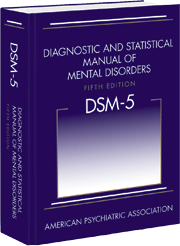
DSM-5_3DThe long awaited and controversial Diagnostic and Statistical Manual of Mental Disorders, version five (DSM-V) is slated to come out toward the end of this month.

The Diagnostic and Statistical Manual of Mental Disorders (DSM) is considered the bible of psychiatry. It is the guide we use in the mental health field to help us diagnose clients and this May, the newest version of the DSM, version five, is slated to be released, but not without much controversy.

The DSM is considered a research standard worldwide, yet, outside of the United States it is rarely used. Still, what is in the DSM is of international concern because trends in diagnosing in the United States (i.e., attention deficit disorder, autism) tend to spread worldwide especially in many European countries, China, Japan and Brazil.

Much of the criticism about the DSM comes from both the way illnesses are categorized and the ever expanding criteria for mental illness that basically makes everyday life issues a diagnosis.

Other  criticisms include weak scientific support and poor reliability in some of the DSM-V field trials, which leave some to believe that it will lose its role as the international standard for research journals.

One of the real dangers if the DSM-V is really that severely flawed is that all of the mental health field will also become tainted, with people not trusting those who are trusted to test, diagnose and help people in need.

With the DSM-V, we also put ourselves at more risk of mis-diagnosing, over-diagnosing and over-medicating individuals.

Some say that the changes to disorders such as Generalized Anxiety Disorder can include almost everyone, as well as a proposed new diagnoses called Somatic Symptom Disorder which will be diagnosed to any patient who has “excessive and disproportionate thoughts, feelings and behaviors” in relationship to an illness, which includes chronic pain and cancer. How much worry constitutes “excessive” worrying. Who wouldn’t be worried when they are dealing with a painful, chronic, potentially debilitating or life threatening illness?

Some believe that much of the flaws in the DSM period are because disorders are placed in discrete categories such as Bipolar Disorder and Schizophrenia, instead of “dimensionality” in which mental illnesses may overlap and people may be placed on one of several spectra such as the proposed Autistic Spectrum Disorders.

Most clients I see have a combination of symptoms, some which do not meet complete criteria for one specific diagnosis, but can meet several others and present differently at different periods, which is why I may see a client who has received three different diagnosis over the same number of years.

However, most in the mental health field prefer for mental disorders to continue to be categories as they already are which is one reason dimensionality won’t likely be introduced into the DSM anytime soon even in the face of growing evidence that disorders are more fluid and less rigid than previously thought.

It would take more research and funding into dimensionality for it to truly be accepted, but much of that research and funding is already put into confirming the categorization of mental disorders the way they already are.

Basically, people don’t really want change. Much of the mental health field, drug and insurance companies, like the rigidity of the DSM even though it is clear that it is failing many people.

Even patient groups and charities prefer the rigidity of the DSM because it highlights their disorder and keeps it visible. They do not want to see schizophrenia or bipolar disorder re-labeled into a spectrum just as Aspergers Disorder is slated to be dissolved into the autistic spectrum disorders.

On top of that health-insurance in the United States pay for treatment based on current DSM diagnosis. As a matter of fact, that is one of the most frustrating things about dealing with insurances.

In order to get paid for my services, they want a diagnosis almost immediately, usually after the first session or two of me meeting a client. Sometimes a DSM diagnosis is obvious, other times it is not and more time with the client is needed, but insurance companies won’t pay for that unless you diagnose them with something first. Insurance companies are probably the last ones who want to see the DSM categories dissolved.

According to Dr. Allen Francis, former chair of the DSM IV task force, the ten worse changes to the DSM-V are:

1) Disruptive Mood Dysregulation Disorder: DSM 5 will turn temper tantrums into a mental disorder- a puzzling decision based on the work of only one research group. We have no idea whatever how this untested new diagnosis will play out in real life practice settings, but my fear is that it will exacerbate, not relieve, the already excessive and inappropriate use of medication in young children. During the past two decades, child psychiatry has already provoked three fads- a tripling of Attention Deficit Disorder, a more than twenty-times increase in Autistic Disorder, and a forty-times increase in childhood Bipolar Disorder. The field should have felt chastened by this sorry track record and should engage itself now in the crucial task of educating practitioners and the public about the difficulty of accurately diagnosing children and the risks of over- medicating them. DSM 5 should not be adding a new disorder likely to result in a new fad and even more inappropriate medication use in vulnerable children.

2) Normal grief will become Major Depressive Disorder, thus medicalizing and trivializing our expectable and necessary emotional reactions to the loss of a loved one and substituting pills and superficial medical rituals for the deep consolations of family, friends, religion, and the resiliency that comes with time and the acceptance of the limitations of life.

3) The everyday forgetting characteristic of old age will now be misdiagnosed as Minor Neurocognitive Disorder, creating a huge false positive population of people who are not at special risk for dementia. Since there is no effective treatment for this ‘condition’ (or for dementia), the label provides absolutely no benefit (while creating great anxiety) even for those at true risk for later developing dementia. It is a dead loss for the many who will be mislabeled.

4) DSM 5 will likely trigger a fad of Adult Attention Deficit Disorder leading to widespread misuse of stimulant drugs for performance enhancement and recreation and contributing to the already large illegal secondary market in diverted prescription drugs.

5) Excessive eating 12 times in 3 months is no longer just a manifestation of gluttony and the easy availability of really great tasting food. DSM 5 has instead turned it into a psychiatric illness called Binge Eating Disorder.

6) The changes in the DSM 5 definition of Autism will result in lowered rates- 10% according to estimates by the DSM 5 work group, perhaps 50% according to outside research groups. This reduction can be seen as beneficial in the sense that the diagnosis of Autism will be more accurate and specific- but advocates understandably fear a disruption in needed school services. Here the DSM 5 problem is not so much a bad decision, but the misleading promises that it will have no impact on rates of disorder or of service delivery. School services should be tied more to educational need, less to a controversial psychiatric diagnosis created for clinical (not educational) purposes and whose rate is so sensitive to small changes in definition and assessment.

7) First time substance abusers will be lumped in definitionally in with hard core addicts despite their very different treatment needs and prognosis and the stigma this will cause.

8) DSM 5 has created a slippery slope by introducing the concept of Behavioral Addictions that eventually can spread to make a mental disorder of everything we like to do a lot. Watch out for careless overdiagnosis of internet and sex addiction and the development of lucrative treatment programs to exploit these new markets.

9) DSM 5 obscures the already fuzzy boundary been Generalized Anxiety Disorder and the worries of everyday life. Small changes in definition can create millions of anxious new ‘patients’ and expand the already widespread practice of inappropriately prescribing addicting anti-anxiety medications.

10) DSM 5 has opened the gate even further to the already existing problem of misdiagnosis of PTSD in forensic settings.

DSM 5 has dropped its pretension to being a paradigm shift in psychiatric diagnosis and instead (in a dramatic 180 degree turn) now makes the equally misleading claim that it is a conservative document that will have minimal impact on the rates of psychiatric diagnosis and in the consequent provision of inappropriate treatment. This is an untenable claim that DSM 5 cannot possibly support because, for completely unfathomable reasons, it never took the simple and inexpensive step of actually studying the impact of DSM on rates in real world settings.

Even with much of it’s flaws and criticisms, the DSM-V is likely to be the best guide for diagnosing mental disorders that we have had thus far. We can only hope that with further research and funding, the next revision of the DSM will be better and more forward thinking.

My Journey To Becoming A Therapist

couch_wide-eb7410d70ac8d556c8331f723e49c918ec26f2dd-s6-c10“What made you want to become a therapist?” That’s one of the most frequent questions I get asked by adults, many who marvel at me as if the ability to sit with, empathize, listen to and accept someone just as they are is some mystical superpower bestowed upon a select few.

Many follow that question by saying that they wouldn’t be able to deal with talking with “crazy people” or emotionally disturbed children all day without going crazy themselves, even saying that they can’t  deal with their own children, friends or family members when they are angry, sad or being irrational.

There was a time when I thought that counseling was something any and everyone could do, but now I know that not everyone can or should be a therapist. I’ve met some very bad therapists, people who may have had the education and credentials to counsel people, but definitely didn’t have the heart, patience or personality that is just as important if not more so.

Thankfully, most of these counselors learned pretty quickly that sitting down and helping someone unravel the complexities of their lives weren’t for them and ended up either getting out of the helping profession all together or moved to a part of the field that was less people oriented, such as working for insurance companies or becoming program directors.

I’ve witnessed teachers, administrators and other professional adults with good intentions do some very bad counseling. Some even made me cringe at either their bad advice, judgmental attitudes or total lack of empathy and I honestly was very thankful and relieved that these individuals weren’t officially counselors.

Being a therapist pretty much comes natural to me. Growing up I was always a very intuitive, carrying and empathetic person. I was always in touch with my feelings and would spend ours alone just trying to figure out why I felt a certain way. That curiosity soon lead to wandering why other people felt certain ways and why they did or didn’t do certain things. People watching became one of my favorite past-times.

In high school I was the person that girls would call and talk to about their problems with their parents, friends or boyfriends. I enjoyed helping them figure out and solve their problems  just as I enjoyed sitting in deep reflection about my own. I was probably one of the only boys in my high school that keep a journal and read self-help books.

Still, at that time I wasn’t even thinking about becoming a counselor. At that time I was interested in becoming a writer, an artist, a dentist or a meteorologist.

In college I decided I wanted to lean towards becoming a writer or an English teacher. I enjoyed writing just as I do today and it was writing that lead me to psychology. I was always interested in making my characters real and multi-dimensional which lead me to reading books on character development and eventually personalities and personality disorders.

There I found my love for psychology.

Soon I started taking every psychology course I could because I found it interested, but even more so because it helped with my writing. This is where I came in contact with Dr. Skinner who was not only my favorite psychology professor, but also became one of my first and most important mentor. He was always encouraging me to further my education in psychology which is one of the main reasons I decided to go on to graduate school.

In graduate school I initially was going to become a guidance counselor because I wanted to work with teenagers, but after taking all the courses required for guidance counseling, I still felt a hunger to learn more about psychology and counseling in general and so I transferred to the counseling and psychology track which was a lot of hard work when it came to reading, writing papers and giving presentations almost constantly.

It was learning the stuff I loved which is why I maintained a 4.0 throughout graduate school while working as a substitute teacher.

It was in graduate school that I started doing official counseling, and I was terrified!  To graduate from the program you had to do a 1,000 hour internship, not with friends or people I already knew, but complete strangers. To make it worst, I knew that I never wanted to be a substance abuse counselor and yet, my internship was at an inpatient substance abuse facility. I was determined to hate it.

I grew up in an inner-city neighborhood. I grew up around drug addicts. I already had my prejudices about people who used drugs and didn’t want to have to deal with them more than I already had growing up.

My dad also had struggled with substance addiction pretty much my whole life. He had been in and out of numerous treatment facilities and I had decided that substance abuse counseling just didn’t work. I tried my hardest to get my internship site changed, but couldn’t.

By the end of my 1,000 hour internship filled with individual, group and family counseling, I had a new respect for those who struggle with addictions and their families. I met people who had been trying to get sober since the 1970s! I met a popular high school football coach who gave up everything, his wife, kids and his prized job for alcohol.

I met women, mothers and daughters, so addicted to drugs and alcohol that their families had them committed to treatment and they were some of the sweetest women you could ever meet, who struggled everyday to control their cravings and stay clean.

Sure it was hard work, sometimes frustrating, disappointing and hard breaking (relapse is a b*tch), but it helped me deal with one of my own demons… it helped me understand my father and his battle with addiction so much better. It allowed me to forgive him.

After graduating I moved on from addiction counseling, perhaps it was still too close to home, and went to work in a psychiatric hospital. I always wanted to work with the severely mentally ill. dsmiv-c317a8bc457aaab1c0fb6b1a1de2b813d655dd09-s6-c10

In the Diagnostic and Statistic Manual of Mental Disorders (DSM) taught to us in school, I had learned so much about schizophrenia, bipolar disorder and other conditions that are rarely seen, yet I wanted to experience them face to face.

I spent three years working overnight in the psychiatric hospital giving psychological evaluations and crisis counseling to some of the most fascinating people ever.

I’ll never forget talking to a rather lucid schizophrenic woman who was having visual hallucinations. She gave me the best explanation of visual hallucinations ever, better than any professor or textbook I had ever read.

I remember trying to calm down a paranoid schizophrenic woman who was shaking like a leaf because she believed a killer was locked in the hospital with us and was specifically trying to kill her.

And I remember giving an evaluation to a tomato red faced woman (all the blood vessels in her face had broken) who had just been released from the hospital after trying to hang herself after finding out her husband was cheating on her.

So many experiences came from my time there, but I knew I was missing out on truly developing my counseling skills. One of my goals was to become a licensed mental health counselor, which is a whole lot of extra work after graduate school and I believed to be a great therapist, I had to know how to not only assess, diagnose and do crisis counseling, but also how to do more traditional counseling with clients who had more everyday type problem.

I still longed to work with children as well so I left the hospital and started working at an inner city high school, focusing mainly on anger management and substance abuse, but soon my job description expanded to include pretty much any and everything that stood in a child’s way of being able to concentrate and focus on their school work.

This is where I learned to work with defiant teens, broken families, damaged teens and teens who just needed someone to guide, care for and encourage them. This is where I saw our future, both promising and disheartening.

While here I also attained my goal of becoming a licensed mental health counselor and continue to learn every single day.

One of the most important things I learned is self-care and to take breaks for myself. Carrying the weight of so many other peoples problems can sneak up on you and break you down before you know it. Sometimes when people know you are a counselor, they will purposely or inadvertently dump their problems on you and that includes family and friends. It becomes important to take the counseling hat off sometimes and if that means going and sitting some place alone, then that’s what I will do.

Being a counselor/therapist is a very rewarding career, but it is probably one of the most mentally and emotionally draining careers I can think of. I enjoy the skills I have developed to analyze people, to read body languages and to be able to already have some ideal what’s going on with a person before he or she even says a word, but sometimes it’s hard to turn that off which sometimes impact my personal life.

One minute a friend will be asking me for advice or wanting to talk to me about a problem, but they don’t want me to “counsel” them. Then the next minute when I make a statement, they will stay “get out of my head” or “stop analyzing me”.

Sometimes I am more comfortable when I am in the counseling role and I will find myself retreating to that mode whenever I am uncomfortable or meeting someone new… not always a good thing. I realize it’s a defense mechanism I use where I limit the amount of information a person knows about me while I gain tons of information about them. That isn’t really fair, but I do it all the time and most people are so happy to talk about themselves that they never call me out on or even notice it.

Lastly, another thing I’ve learned is that being authentic with someone… being present with them and actively listening does miracles. There’s been times when I listened to someone and was present with them, but had no real ideal what to do or say, and after our session they were so grateful to me for listening to and helping them. It’s amazing. Sometimes I didn’t even say a word and yet they would be so grateful. That’s why I stress so much on listening, rather than talking in this blog. I believe that listening sometimes solves more problems than talking, lecturing or berating someone.

STDs and Pregnancy Scares: My Week In Review

immigration.istock-e1335353696609Last week was a super busy and crazy week. It seemed like I couldn’t get a handle on anything. On top of the many clients I already see, the referrals were pouring in and I only got a chance to meet with a couple of those, the most serious ones, two girls who had attempted suicide recently and had been hospitalized.

I met with both of them once and just kind of introduced myself, explained what counseling was and wasn’t since neither one of them had ever been in counseling before, and then started trying to build rapport with them. Both are very damaged young ladies, but I think we all are to some extent. They both, just from their presence, scream some type of past history of abuse to me, and one is living with a parent with a severe mental illness and drug addiction, so you can imagine the affects that will have on a teenager.

Besides that I had two clients that thought they might be pregnant. One is 17 and one is 16 and the sad thing is, as much as they say they don’t want to be pregnant, I think they really do want to be pregnant because neither one of them are doing anything to prevent becoming pregnant. If they aren’t pregnant, then it’s probably only a short matter of time before they will be.

Neither of them are mentally mature enough to be mothers, despite their biological maturation. One is really naive and I am sure she thinks that being pregnant will make the boy she’s sleeping with (who is not her boyfriend) commit to her. The other has severe low-self esteem and is very emotionally unstable, she says she is ready to be a mother, but mentally she acts about two years below her chronological age.

Talking to these young ladies, it’s clear that neither one of them have any idea of the dedication and sacrifice that goes into being a parent, but they don’t see a baby as a responsibility, but as a solution to one problem or another.

Still on the topic of teenage sex, another female client came to me crying because she thinks she may have a sexually transmitted disease. I referred her to the school nurse and then to a community clinic since she doesn’t want her mother to know.

This girl is very sexually active and at 16, claims she has had about 20 sexual partners. She doesn’t open up much, but I am working on helping her build her self-esteem and I am almost 100% sure that there is a history of sexual abuse, but she hasn’t disclosed that as of yet. She talks a lot about her mother, whom I haven’t met yet, but from what the she says, her mother seems to be just as promiscuous and I am sure that affects this client’s behavior and relationships with males.

We did talk about her father whom she felt abandoned her when she was young and I think that explains at least in part why she is always trying to be with one guy or several. That on top of her mother’s influences on her and her low self-esteem (she once told me that the only thing she likes about herself was her hair), all contribute to her risky sexual behavior.

She’s supposed to go to the clinic this week so hopefully she’ll find out that everything is okay or at least is treatable.

And then on Friday, while I was facilitating a group, I looked up and saw two female sheriff detectives standing at my door. I was immediately dismayed because I had no idea what they wanted to talk to me about. Ends up, one of my clients reported being sexually abused and the detectives were there to ask me what I knew about it.

It initially felt a little intimidating, like an interrogation because none of the answers I gave them seemed to be concise enough, and they kept pushing, but I was treading on giving them information I knew I legally and ethically should give them while also respecting my clients confidentiality by not giving them information unrelated/unnecessary to  their investigation.

In the end I think I did both well, but it was definitely an experience. It was my first time ever having to deal with detectives in that manner although I make suspected abuse and neglect calls to child services all the time.

That was a rather stressful way to end the week on top of everything else, but I left work on Friday and ran four miles with one a friend which was a great way to distress while venting. Taking care of yourself physically, mentally and spiritually is a must in the helping professions or you’ll succumb to burnout and compassion fatigue, places I know all too well and try to prevent with every fiber of my being through self-care, which is sometimes easier said then done.

Abuse Reports And Pregnancy Scares: My Week In Review

istock_000007374203small2-614x257

This week went by really fast, although it was tiresome and very busy, picking up where last week left off.

Last Friday I had to have a suicidal student Baker Acted (Florida’s statute for involuntary examination/hospitalization), with five minutes of school left, which meant I had to deal with law enforcement and the Department of Children and Families (DCF) for two hours afterwards.

Not the best way to start my weekend.

This week wasn’t as dramatic, but I still had to call DCF on three cases for suspected physical abuse, suspected medical neglect and suspected sexual abuse.

I don’t know why, but I am still at times amazed at the amount of damage done to our kids at the hands of those who are supposed to love, support and watch over them.

Making DCF reports or Baker Acting a client is never the easiest thing to do. Often times clients are initially angry, or scared, but many times they are relieved to finally be getting help, and more often than not, after it’s all over with, they are grateful someone cared enough to get them help.

I even had a mother come in to try to assure me that her daughter is not being abused by her husband, but I tend to believe what her daughter is telling me and will support the daughter psychologically while DCF does their own investigation.

I also had three of my female clients this week tell me that they thought they were pregnant.

I always hate hearing this because I know the affect having a child can have on these inner-city young girls who have enough to overcome already.

Most of the times these young girls think that they can get pregnant and nothing in their lives will change. I remind them that every girl that was in my program last year that got pregnant have dropped out of school.

I was saddened also that these three young girls, all good and intelligent students, weren’t using protection and are potentially pregnant by guys that aren’t even their boyfriends.

It’s one thing to be pregnant by a boy who is supposed to be committed to them, but it’s another thing for a young girl to be pregnant by a boy who has no commitment to them at all.

“Hooking up” seems to be the thing with this generation, in which teens are more likely to have no-strings-attached, physical relationships that could include anything from kissing to intercourse.

Friends with benefits definitely seems to be more popular than actual dating, at least on the campus I work at.

These girls I am referring to, of course really like these boys and want to be with them in a monogamous relationship, but are willing to accept the friends with benefit role, which gives these boys no real reason to commit and give the girl what she truly wants, a relationship with a guy that cares for only her.

These young girls, as much as they would hate to admit it, aren’t emotionally prepared for no-strings attached sex as well as they think, which is one reason many of them are so angry, depressed, emotional and unhappy.

They are clueless about the connection between the body, the heart and the mind.

Luckily, so far one out of the three girls I mentioned has found out she is not pregnant, while the other two are too afraid to take pregnancy tests or go to their family doctor, so they are practicing the wait, see, and pray method.

Two of the girls asked me if I was mad at them (I’ve counseled them numerous times about self-esteem, self-respect, abstinence and using protection if they are going to be sexually active).

I told  them that I wasn’t mad and that I never get mad at them, because it’s true. I did admit to them that I was a bit disappointed in them, because that too is true.

I still care for them and support them unconditionally, even when I don’t like the decisions they’ve made..

Hopefully in the next few days, the other two girls will find out if they are pregnant or not so I can either help them learn to prevent this from happening again anytime soon, or help them prepare to be the best teenage mothers they can be.

Support Groups for College Students

College can be a huge transition for students that usually leads to personal growth, but at times may lead to feelings of loneliness, anxiety and depression.

Many students who I’ve worked with in high school and have graduated and gone off to college, have kept in touch, expressing at times their struggle to adjust or to stay balanced.

Usually I’ll give these students some words of advice or resources I think will help them get back on track, but sometimes they need more attention than I can provide and that’s when I often refer them to a support group on their campus.

There are usually support groups for almost any and every issue a college student may be dealing with including:

Depression and Anxiety

Sudden independence, academic pressure, financial worries and adapting to a new environment are all things that can lead to stress and anxiety, especially among freshman.

Stress and anxiety can lead to depression which can cause a host of other problems including dropping out of school and substance abuse. Most college campuses offer groups such as “Personal Growth” or  “Transitioning into College”  to serve students with these needs.

There are also grief and loss support groups for students dealing with the loss of someone.

Self Esteem

In college, people often start discovering new things about themselves, things they may like, dislike, feel uncomfortable with or are not quite sure of  how to deal with their feelings. This is also the time some people have their first sexual experiences either with the opposite sex or with the same sex.

Some may feel like they don’t fit into the student body on campus for various reasons.

These groups help people suffering with self-esteem and identity issues figure those things out in a safe, confidential environment.

Most college campuses offer support groups, for example, for the gay, lesbian, bisexual and transgender community and for people who have been sexually assaulted. The University of Central Florida, for example has a group called Sister Circle, which gives support to women of color.

Recovery

There are also groups for students dealing with drug and alcohol problems in order to help them stay on the track of recovery. In recovery, it’s very important that a person has a good support system, which is what these groups attempt to provide.

Here is an example of support groups offered at the University of Central Florida and similar groups are found on most college campuses:

  • GLBQ (Gay, Lesbian, Bisexual, Questioning) Growth & Empowerment
  • Sexual Assault Survivors
  • Transgender Bender Group
  • Authentic Connections
  • Women’s Group
  • Creative Connections
  • Exploring your Family
  • Grief and Loss
  • Sister Circle
  • Building Social Confidence

Generally once I’ve connected a student to a support group on campus not only do I feel relieved, but they also tend to improve and make new friends. I’ve always been a proponent of support groups for everyone in need because I know the positive affects they can have on their members.

The Symbiotic Relationship of Counseling and Unconditional Positive Regard

As another school year ends I look back at all the clients I’ve worked with during the school year and a good majority have made major changes. I’ve seen teens who could barely stay in school for a month because of getting suspended, end up having zero discipline issues for the last five months or more. I’ve seen kids with alcohol and marijuana problems minimize and some totally quit using and even more importantly I’ve seen kids I thought would take years to make positive gains make dramatic changes over a few months. 

I give all my clients surveys before discharging them so that they can voice how I have helped them or didn’t help them so that I could better myself in the future and this year I became emotional as I read over some of their responses. Some kids wrote things such as

  • “You helped me have a better relationship with my mother”
  • “You helped me realize that killing myself isn’t the answer”
  • “You helped me learn to love myself”
  • “You helped me learn how to get along with my baby’s father and take better care of my baby”
  • “I’ve learned to control my anger and how to express my emotions”
  • “You helped me learn how to get along with my baby’s mother and get more into my son’s life”
  • “You helped me realize how valuable my life is and how stupid and irresponsible ending it would be”
  • “I don’t smoke or drink any more and started liking myself”


This comments really touched me and made me feel blessed to have had such an impact on these kids and they have had major impacts on me as well. I’ve learned just as much about them about patience and the importance of bringing the family into counseling whenever possible and appropriate. I look back and try to reflect on all the things and activities I’ve done with these kids and while I’ve used a lot of counseling techniques, I think the one thing that made the biggest impact is the unconditional positive regard I’ve showed these kids. Unconditional positive regard is accepting someone as they are and not judging them and I showed these kids throughout the year that I liked and accepting them despite anything they did or said. Sure they often did things I didn’t approve of, but I always let them know that it was the act that I disapproved of and not them. A lot of these kids have never had anyone they could just talk to who accepted and didn’t judge them and I think building on that relationship overtime had the greatest impact.

A lot of times I hear interns and new counselors saying that they are afraid that they are afraid that they won’t always know what to say and I always tell them that it’s okay, sometimes I don’t know what to say and so I say nothing, I just listen and show unconditional positive regard and empathy instead of not being present in the situation because I am busy searching for the right thing to say when there likely isn’t. In a good counseling relationship it is symbiotic. I learn from them and they learn from me and that is one of the things I love best about being a counselor. I learn from even the most difficult of clients and hopefully they learn from me as well.