Mental Health Awareness Week: Borderline Personality Disorder

istock_000008463493xsmall-243x300Perhaps out of all of the different types of personality disorders, borderline personality disorder is the most studied and most known as it seems like more and more people today are being diagnosed with borderline personality disorder (BPD) and it was definitely one of the most common personality disorders I run into when working with teenage girls.

People with borderline personality disorder are said to stand on the threshold between neurosis and psychosis. They are characterized by their incredibly unstable affect, behavior, mood, self-image and object relations (how they relate to others).

Borderline personality disorder is thought to represent about 1 to 2 percent of the population and is twice as common in women compared to men.

People who have borderline personality disorder seem to be in a constant state of crisis. They experience almost every emotion to the extreme and typically have mood swings. They can go from being very angry and confrontational one moment, to crying the next moment to feeling nothing at all the very next. They may even have very brief periods of psychosis known as micropsychotic episodes that are generally not as bizarre as those who have full-blown psychotic breaks and may even go largely unnoticed or written off as “strange”.

The behavior of people with BPD is highly unpredictable and they generally do not achieve everything they can to their full potential. Their lives are usually marred by repetitive, self-destructive actions.

These individuals are very often associated with cutting and other self-injurious behaviors as they may harm themselves as a way of crying out for help, to express anger or to feel pain or numb themselves from intense and overwhelming emotions and affect. As a matter of fact, most of the young women I ended up counseling who had BPD were referred to me for their self-injurious behaviors and/or their intense mood swings.

They may feel both dependent and hostile which creates an environment for stormy interpersonal relationships. They can be dependent on the people they are closest to, yet lash out with intense anger at the smallest perceived slight or frustration. They basically pull and push people away all the time, yet they can not tolerate being alone and will prefer chasing and trying to have relationships with people who are not good for them, even if they themselves are not satisfied in the relationship. They tend to prefer that roller coaster over their own company.

They will complain about being treated like crap in their relationships, discuss leaving their partner, yet if their partner doesn’t respond to their text or phone call they will panic and do whatever it takes to track them down.

When they are forced to be alone, even briefly, they will take a stranger as a friend or become promiscuous to fill the loneliness they feel. They are often trying to fill the void of chronic feelings of emptiness, boredom and lack of a sense of identity. They may even complain about how depressed they feel despite all the other emotions that they usually display.

People with borderline personality disorder tend to distort their relationships by characterizing people to be all good or all bad. They will see people as either nurturing or as evil, hateful figures that threaten their security needs and are always threatening to abandon them whenever they feel dependent. The good person, even if they really are not a good person, then gets idealized while the bad person, even if they really are good, gets devalued. More often than not, the same person can be seen as good one moment and bad the next, meaning that a woman can see her husband as perfect and caring today and tomorrow he is the most evil man in the world and she hates his guts, even if nothing really changed between them over the last twenty-four hours.

This aspect of BPD I found extremely frustrating at times because one moment a client would see me as the only person in the world who could understand and help her and the next session she would treat me like she hated me and like I hadn’t ever helped her. One client in particular for instance was chatting with me like I was her best friend one week, the next week when I was redirecting a negative statement she made about herself she said “F*ck you” out of the blue and walked out of the room, only to come back the next week and apologize, but this cycle repeated itself over and  over again. It wasn’t uncommon for her to tell me in one session that she “couldn’t stand me” and the next session tell me that I was the only one who understood her.

Another reason people with BPD are trying even for therapists is that they are very good at subconsciously projecting a role unto someone and getting that person to unconsciously play that role. It can be very draining and even scary trying to deal with someone who has BPD as their impulsiveness and instability as well as their dependency needs can make them overwhelming for many people.

For the most part, this particular client and all other clients I’ve dealt with who had BPD were overall pleasant people with great personalities whenever they were in a good mood and I generally enjoyed our sessions, but there were times when they made therapy so difficult that although I enjoyed working with them, I was relieved when I was able to discharge them, not that I was happy to get rid of them so to say, but it was draining and by then I felt like I had given them everything they could have learned from me and now needed to practice the skills they built up with others.

 DSM-IV-TR Diagnostic Criteria for Borderline Personality Disorder

The Diagnostic and Statistical Manual of Mental Disorders (DSM) is what we use in the mental health field to diagnose mental disorders and personality disorders and it list the criteria for BPD as:

A pervasive pattern of instability of interpersonal relationships, self-image and affects, and marked impulsivity beginning by early adulthood and present in a variety of contexts, as indicated by five (or more) of the following:

1)   Frantic efforts to avoid real or imagined abandonment.

Note:  Do not include suicidal or self-mutilating behavior covered in Criterion 5.

2)   A pattern of unstable and intense interpersonal relationships characterized by alternating between  extremes of idealization and devaluation.

3)  Identity disturbance:  markedly and persistently unstable self-image or sense of self.

4)   Impulsivity in at least two areas that are potentially self-damaging (e.g., spending, sex, substance abuse, reckless driving, binge eating).

Note: Do not include suicidal or self-mutilating behavior covered in Criterion 5.

5)   Recurrent suicidal behavior, gestures, or threats, or self-mutilating behavior.

6)   Affective [mood] instability.

7)   Chronic feelings of emptiness.

8)   Inappropriate, intense anger or difficulty controlling anger (e.g., frequent displays of temper, constant anger, recurrent physical fights).

9)   Transient, stress-related paranoid ideation or severe dissociative symptoms.

 Treatment

Psychotherapy has had the best results for treating individuals with borderline personality disorder, especially when combined with pharmacotherapy. Reality-oriented and social skills training are ideal in order to help people with BPD see how their actions affect others. Intense psychotherapy on an individual and group level is often recommended to help clients work on their interpersonal skills and to deal with their self-destructive and self-injurious behaviors.

Dialectical behavior therapy (DBT) is a specific type of psychotherapy that works great with people who have borderline personality disorder, especially those who do self-harm behaviors like cutting. It has perhaps gotten the best recognition for being high effective with people who have BPD.

I mostly used psychotherapy in the form of cognitive behavioral therapy, but later started utilizing much of DBT and it proved to work faster if not better than traditional cognitive behavioral therapy.

More Information

There are some great books on borderline personality disorder, but I recommend the classic, I Hate You- Don’t Leave Me: Understanding Borderline Personality Disorder by Kreisman MD, Jerold J. and Hal Straus as a great place to start.

www.borderlinepersonalitydisorder.com  is another great resource and they even have a list of movies with characters who have BPD and they include:

Fatal Attraction (1987)

In “Fatal Attraction,” the infamous femme fatale character played by Glenn Close displays the emotional instability and fear of abandonment that are symptomatic of someone with Borderline Personality Disorder. Her character also exhibits the BPD symptoms of self-harm, intense anger, and manipulation as she stalks her former lover and his family.

Single White Female (1992)

Jennifer Jason Leigh’s character in “Single White Female” exhibits the Borderline Personality Disorder symptoms of fear of abandonment, impulsivity, and mirroring as she attempts to take over the persona and life of her roommate (Bridget Fonda).

Girl, Interrupted (1999)

“Girl, Interrupted” is based on the memoir of Susanna Kaysen, who struggled with mental illness and Borderline Personality Disorder as a teenager and young adult. The film, which stars Winona Ryder and Angelina Jolie, centers around Kaysen’s 18-month stay at a mental hospital.

Hours (2002)

The three main characters in “The Hours,” which include author Virginia Woolf, all struggle with Borderline Personality Disorder, depression, and suicide. The movie, which links women from different generations to Woolf’s book “Mrs. Dalloway,” stars Nicole Kidman, Meryl Streep, and Julianne Moore.

Monster (2003)

Charlize Theron transformed into the role of female serial killer Aileen Wuornos in “Monster.” Wuornos was diagnosed with Borderline Personality Disorder, which may have contributed to the unstable and angry behaviors that led to her killing at least six men.

My Super Ex-Girlfriend (2006)

One of the few comedy movies that features a character with Borderline Personality Disorder is “My Super Ex-Girlfriend.” In this movie, Uma Thurman portrays a woman with superpowers and a secret identity who also displays the BPD symptoms of impulsivity, unstable interpersonal relationships, and poor self-image.

The DSM-V: Coming Soon, Criticisms, Flaws and All

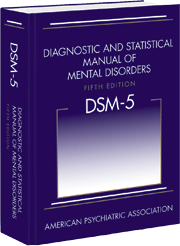
DSM-5_3DThe long awaited and controversial Diagnostic and Statistical Manual of Mental Disorders, version five (DSM-V) is slated to come out toward the end of this month.

The Diagnostic and Statistical Manual of Mental Disorders (DSM) is considered the bible of psychiatry. It is the guide we use in the mental health field to help us diagnose clients and this May, the newest version of the DSM, version five, is slated to be released, but not without much controversy.

The DSM is considered a research standard worldwide, yet, outside of the United States it is rarely used. Still, what is in the DSM is of international concern because trends in diagnosing in the United States (i.e., attention deficit disorder, autism) tend to spread worldwide especially in many European countries, China, Japan and Brazil.

Much of the criticism about the DSM comes from both the way illnesses are categorized and the ever expanding criteria for mental illness that basically makes everyday life issues a diagnosis.

Other  criticisms include weak scientific support and poor reliability in some of the DSM-V field trials, which leave some to believe that it will lose its role as the international standard for research journals.

One of the real dangers if the DSM-V is really that severely flawed is that all of the mental health field will also become tainted, with people not trusting those who are trusted to test, diagnose and help people in need.

With the DSM-V, we also put ourselves at more risk of mis-diagnosing, over-diagnosing and over-medicating individuals.

Some say that the changes to disorders such as Generalized Anxiety Disorder can include almost everyone, as well as a proposed new diagnoses called Somatic Symptom Disorder which will be diagnosed to any patient who has “excessive and disproportionate thoughts, feelings and behaviors” in relationship to an illness, which includes chronic pain and cancer. How much worry constitutes “excessive” worrying. Who wouldn’t be worried when they are dealing with a painful, chronic, potentially debilitating or life threatening illness?

Some believe that much of the flaws in the DSM period are because disorders are placed in discrete categories such as Bipolar Disorder and Schizophrenia, instead of “dimensionality” in which mental illnesses may overlap and people may be placed on one of several spectra such as the proposed Autistic Spectrum Disorders.

Most clients I see have a combination of symptoms, some which do not meet complete criteria for one specific diagnosis, but can meet several others and present differently at different periods, which is why I may see a client who has received three different diagnosis over the same number of years.

However, most in the mental health field prefer for mental disorders to continue to be categories as they already are which is one reason dimensionality won’t likely be introduced into the DSM anytime soon even in the face of growing evidence that disorders are more fluid and less rigid than previously thought.

It would take more research and funding into dimensionality for it to truly be accepted, but much of that research and funding is already put into confirming the categorization of mental disorders the way they already are.

Basically, people don’t really want change. Much of the mental health field, drug and insurance companies, like the rigidity of the DSM even though it is clear that it is failing many people.

Even patient groups and charities prefer the rigidity of the DSM because it highlights their disorder and keeps it visible. They do not want to see schizophrenia or bipolar disorder re-labeled into a spectrum just as Aspergers Disorder is slated to be dissolved into the autistic spectrum disorders.

On top of that health-insurance in the United States pay for treatment based on current DSM diagnosis. As a matter of fact, that is one of the most frustrating things about dealing with insurances.

In order to get paid for my services, they want a diagnosis almost immediately, usually after the first session or two of me meeting a client. Sometimes a DSM diagnosis is obvious, other times it is not and more time with the client is needed, but insurance companies won’t pay for that unless you diagnose them with something first. Insurance companies are probably the last ones who want to see the DSM categories dissolved.

According to Dr. Allen Francis, former chair of the DSM IV task force, the ten worse changes to the DSM-V are:

1) Disruptive Mood Dysregulation Disorder: DSM 5 will turn temper tantrums into a mental disorder- a puzzling decision based on the work of only one research group. We have no idea whatever how this untested new diagnosis will play out in real life practice settings, but my fear is that it will exacerbate, not relieve, the already excessive and inappropriate use of medication in young children. During the past two decades, child psychiatry has already provoked three fads- a tripling of Attention Deficit Disorder, a more than twenty-times increase in Autistic Disorder, and a forty-times increase in childhood Bipolar Disorder. The field should have felt chastened by this sorry track record and should engage itself now in the crucial task of educating practitioners and the public about the difficulty of accurately diagnosing children and the risks of over- medicating them. DSM 5 should not be adding a new disorder likely to result in a new fad and even more inappropriate medication use in vulnerable children.

2) Normal grief will become Major Depressive Disorder, thus medicalizing and trivializing our expectable and necessary emotional reactions to the loss of a loved one and substituting pills and superficial medical rituals for the deep consolations of family, friends, religion, and the resiliency that comes with time and the acceptance of the limitations of life.

3) The everyday forgetting characteristic of old age will now be misdiagnosed as Minor Neurocognitive Disorder, creating a huge false positive population of people who are not at special risk for dementia. Since there is no effective treatment for this ‘condition’ (or for dementia), the label provides absolutely no benefit (while creating great anxiety) even for those at true risk for later developing dementia. It is a dead loss for the many who will be mislabeled.

4) DSM 5 will likely trigger a fad of Adult Attention Deficit Disorder leading to widespread misuse of stimulant drugs for performance enhancement and recreation and contributing to the already large illegal secondary market in diverted prescription drugs.

5) Excessive eating 12 times in 3 months is no longer just a manifestation of gluttony and the easy availability of really great tasting food. DSM 5 has instead turned it into a psychiatric illness called Binge Eating Disorder.

6) The changes in the DSM 5 definition of Autism will result in lowered rates- 10% according to estimates by the DSM 5 work group, perhaps 50% according to outside research groups. This reduction can be seen as beneficial in the sense that the diagnosis of Autism will be more accurate and specific- but advocates understandably fear a disruption in needed school services. Here the DSM 5 problem is not so much a bad decision, but the misleading promises that it will have no impact on rates of disorder or of service delivery. School services should be tied more to educational need, less to a controversial psychiatric diagnosis created for clinical (not educational) purposes and whose rate is so sensitive to small changes in definition and assessment.

7) First time substance abusers will be lumped in definitionally in with hard core addicts despite their very different treatment needs and prognosis and the stigma this will cause.

8) DSM 5 has created a slippery slope by introducing the concept of Behavioral Addictions that eventually can spread to make a mental disorder of everything we like to do a lot. Watch out for careless overdiagnosis of internet and sex addiction and the development of lucrative treatment programs to exploit these new markets.

9) DSM 5 obscures the already fuzzy boundary been Generalized Anxiety Disorder and the worries of everyday life. Small changes in definition can create millions of anxious new ‘patients’ and expand the already widespread practice of inappropriately prescribing addicting anti-anxiety medications.

10) DSM 5 has opened the gate even further to the already existing problem of misdiagnosis of PTSD in forensic settings.

DSM 5 has dropped its pretension to being a paradigm shift in psychiatric diagnosis and instead (in a dramatic 180 degree turn) now makes the equally misleading claim that it is a conservative document that will have minimal impact on the rates of psychiatric diagnosis and in the consequent provision of inappropriate treatment. This is an untenable claim that DSM 5 cannot possibly support because, for completely unfathomable reasons, it never took the simple and inexpensive step of actually studying the impact of DSM on rates in real world settings.

Even with much of it’s flaws and criticisms, the DSM-V is likely to be the best guide for diagnosing mental disorders that we have had thus far. We can only hope that with further research and funding, the next revision of the DSM will be better and more forward thinking.

STDs and Pregnancy Scares: My Week In Review

immigration.istock-e1335353696609Last week was a super busy and crazy week. It seemed like I couldn’t get a handle on anything. On top of the many clients I already see, the referrals were pouring in and I only got a chance to meet with a couple of those, the most serious ones, two girls who had attempted suicide recently and had been hospitalized.

I met with both of them once and just kind of introduced myself, explained what counseling was and wasn’t since neither one of them had ever been in counseling before, and then started trying to build rapport with them. Both are very damaged young ladies, but I think we all are to some extent. They both, just from their presence, scream some type of past history of abuse to me, and one is living with a parent with a severe mental illness and drug addiction, so you can imagine the affects that will have on a teenager.

Besides that I had two clients that thought they might be pregnant. One is 17 and one is 16 and the sad thing is, as much as they say they don’t want to be pregnant, I think they really do want to be pregnant because neither one of them are doing anything to prevent becoming pregnant. If they aren’t pregnant, then it’s probably only a short matter of time before they will be.

Neither of them are mentally mature enough to be mothers, despite their biological maturation. One is really naive and I am sure she thinks that being pregnant will make the boy she’s sleeping with (who is not her boyfriend) commit to her. The other has severe low-self esteem and is very emotionally unstable, she says she is ready to be a mother, but mentally she acts about two years below her chronological age.

Talking to these young ladies, it’s clear that neither one of them have any idea of the dedication and sacrifice that goes into being a parent, but they don’t see a baby as a responsibility, but as a solution to one problem or another.

Still on the topic of teenage sex, another female client came to me crying because she thinks she may have a sexually transmitted disease. I referred her to the school nurse and then to a community clinic since she doesn’t want her mother to know.

This girl is very sexually active and at 16, claims she has had about 20 sexual partners. She doesn’t open up much, but I am working on helping her build her self-esteem and I am almost 100% sure that there is a history of sexual abuse, but she hasn’t disclosed that as of yet. She talks a lot about her mother, whom I haven’t met yet, but from what the she says, her mother seems to be just as promiscuous and I am sure that affects this client’s behavior and relationships with males.

We did talk about her father whom she felt abandoned her when she was young and I think that explains at least in part why she is always trying to be with one guy or several. That on top of her mother’s influences on her and her low self-esteem (she once told me that the only thing she likes about herself was her hair), all contribute to her risky sexual behavior.

She’s supposed to go to the clinic this week so hopefully she’ll find out that everything is okay or at least is treatable.

And then on Friday, while I was facilitating a group, I looked up and saw two female sheriff detectives standing at my door. I was immediately dismayed because I had no idea what they wanted to talk to me about. Ends up, one of my clients reported being sexually abused and the detectives were there to ask me what I knew about it.

It initially felt a little intimidating, like an interrogation because none of the answers I gave them seemed to be concise enough, and they kept pushing, but I was treading on giving them information I knew I legally and ethically should give them while also respecting my clients confidentiality by not giving them information unrelated/unnecessary to  their investigation.

In the end I think I did both well, but it was definitely an experience. It was my first time ever having to deal with detectives in that manner although I make suspected abuse and neglect calls to child services all the time.

That was a rather stressful way to end the week on top of everything else, but I left work on Friday and ran four miles with one a friend which was a great way to distress while venting. Taking care of yourself physically, mentally and spiritually is a must in the helping professions or you’ll succumb to burnout and compassion fatigue, places I know all too well and try to prevent with every fiber of my being through self-care, which is sometimes easier said then done.

Combating Depression: 10 Tips

depressionistockDepression affects about 17. 5 million Americans and out of those, an estimated 9.2 million will have what is considered major or clinical depression.

What’s the difference between depression and major depression?

Major depression is categorized as:

  1. a depressed mood, most of the day, nearly everyday for at least two weeks. In children, adolescence and some adults, depression may present as irritation or anger.
  2. Marked diminished interest in or pleasure in all, or nearly all activities most of the day, nearly everyday.
  3. Significant weight loss (when not dieting), decrease in appetite, or significant weight gain or appetite nearly everyday.
  4. Insomnia or hypersomnia nearly everyday.
  5. Psychomotor agitation or retardation (i.e. moving extremely slow or faster than normal) nearly everyday.
  6. Fatigue or loss of energy nearly everyday.
  7. Feelings or worthlessness or excessive or inappropriate guilt nearly everyday.
  8. Decreased ability to think or concentrate, or indecisiveness nearly everyday.
  9. Recurrent thoughts  of death, suicidal thoughts with or without a plan or a suicide attempt.

A person doesn’t have to have all of these symptoms to be diagnosed as having major depression, but they have to have the majority of these symptoms for at least two weeks and they can’t be accounted for something else, such as bereavement (i.e., losing someone close to them recently).

Depression has been given a bad name and so many people who feel depressed don’t like to admit to it and may not seek help or even the comfort of a friend when they are feeling depressed. The thing about depression in general is that it is not always a bad thing.As a matter of fact, very often, depression is your minds way of telling you that something in your life is not going the way you want it to go.

Instead of ignoring that feeling or trying to make it go away immediately, it may be a good time to sit with it and evaluate your life and see what is it that is not going the way you want it to go, and if you can change it, then change it, if you can’t, then try to change the way you think about it.

More often then not, this is what depression is and it is possible for a person who is in tune with themselves, to take this self-evaluation, correct the problem(s) and eliminate their symptoms. Other times, a depressed person may need the help of a professional to help them analyze what’s going wrong in their lives and help them learn how to deal with it. And yet, still there are times when medication is needed due to chemical imbalances or if a person gets to the point where they are so depressed that they don’t have the capacity to be introspective.

While most of us have or will experience depression at least once in our lifetimes, major depression can be a very dark and dangerous place. The Center for Disease Control has intentional suicide as the number ten cause of death in the United States last year, killing an estimated 38, 364 people.

10 Tips To Fighting Depression

**First off… if you or someone you know is suicidal, don’t be afraid to call 911 or 1-800-suicide for immediate help**

  • Opposite Actions is a technique from Dialectical Behavior Therapy that basically says, do the opposite of what the depression is telling you to do. If you feel like staying in bed all day, get up and do something. If you feel like blowing off your friends, don’t, call them and force yourself to be out with them.  One of the things about depression is that it is a self-feeding disease. It zaps a persons motivation, makes them want to isolate themselves and stop doing things like going to the gym, all of which end up making the person feel more depressed.
  • Set an alarm that will help you wake up, that will remind you to eat, or to do whatever it is you need to do.
  • Take care of yourself by getting out of your bed, making it, and taking a shower. Letting yourself go is one of the hallmarks of being depressed and will make it easier for you to start avoiding other people.
  • Go outside for at least ten minutes a day. It doesn’t matter where you go, or if you don’t go anywhere. Going outside, getting some fresh air, some sun even, can do natural miracles when battling depression.
  • Exercise. You won’t feel like it, but it will be good for you and will get your blood flowing and your endorphin and dopamine (natural feel good hormones) going.
  • Make a list of activities to do, hopefully some will involve other people.
  • Keep a schedule, that way you can stay on track during the days you don’t feel like doing anything.
  • Make a daily necessity schedule if needed that reminds you when to eat, take  a bath, brush your teeth, etc. Yes, in the middle of severe depression, it’s easy to neglect all these things.
  • Visit people like healthy family and friends. Once again, you will feel like isolating yourself, but having good family and friends around will help pull you out of the fog.
  • Last, but not least, if all self-help fails, do not be afraid to see your doctor or a psychotherapist.  80% of people with major depression who received treatment had significant improvements.

Depression will affect us or someone we know to some degree, and it’s always good to have some idea of what you’re dealing with and how to begin fighting it.

Am I An Effective Counselor? A Case Example On Counselor Effectiveness And Struggles When Working With A Client

college-student1Often as a counselor, it’s not always easy to know when I am truly being effective in helping clients live better lives. This can be difficult because clients often lie, not only about their feelings, but also about their behavior, about following through with treatment recommendations and even about getting better.

Clients often put up lots of psychological defenses and resistance that make it difficult to know how effective treatment is being. Many of them learn how to better mask their symptoms, while all the while their depression, anxiety, compulsions, etc. are still raging inside of them, causing marked distress.

Of course there are many ways a counselor can try to verify the effectiveness of treatment such as assessment tools and reaching goals set forth in treatment plans, but most clients know how to fake those as well.

One of the most powerful ways to verify if treatment is being effective is through my own observations of the client during sessions. Clients who are depressed or anxious for example, tend to display those affects during therapy and as they progress, those symptoms tend to decrease and the clients whole persona will seem to improve.

Of course there are the times when a client will tell me how much they have changed, how much I have helped them or how much better they feel from counseling. And times when teachers or parents will tell me about the improvements they have seen in a student I’ve been working with, but sadly, in the school based program I do most of my counseling at, that type of feedback isn’t as common as I would like it to be. Still, when it happens, it feels great.

Case Example

For a little over a year now I’ve been working with a client we’ll call Suriyan. Suriyan came to me after she lost one of her parents suddenly. She was obviously grieving so I started working with her through her grief and put her in my grief counseling group. It was obvious almost immediately that Suriyan was grieving harder than anyone else in the group which consisted of other students her age, all whom had lost a parent within the last year.

Through individual counseling I realized that one of the reasons Suriyan was grieving so hard was because she had a pre-existing issue dealing with depression and self-injury, and on top of that, unlike the rest of the grief counseling group, her grieving is what we call complicated grief. Her parent had not only died suddenly, but she blamed her parent for dying and blamed herself for allowing her parent to die, although her parent died of a disease neither one of them had any control over. They had lots of unfinished business she was internalizing.

She felt that her parent was her best friend and had chosen to abandon her.

Suriyan initially was very resistant to counseling. She rarely participated in group and in individual sessions she would cycle between talking about her feelings, to being extremely angry, to totally shutting down. On top of that, she was cutting herself to deal with the pain and anger, and had become suicidal. She wanted to be with her parent. Her thought was, if my parent didn’t want to be here with me, why should I be here.

I was extremely worried about Suriyan, especially as the weeks went by and her depression wasn’t lifting. I was throwing everything at her, counseling wise, to try to get her to understand that she needed to let go of the anger and guilt she felt for and towards her parent. I felt like I was failing her and wanted to refer her to another counselor, but she didn’t want to see anyone else. As little as I seemed to be helping her, we had built a pretty good therapeutic relationship.

I started reading academic journals on grief, referring to other counselors for clinical advice and reading books as fast as I could to try to find new techniques, but ultimately patience on my part and time appeared to be the most effective technique.

In time her depression seemed to lift and she was able to talk about her parent’s death without placing blame on herself or her parent. She started participating in group, following my recommendations and keeping a journal to write in, which also seemed to help. By the end of last school year she had stopped cutting herself, was happier and was definitely in a better place.

Then summer came.

I tried to make sure over the summer she had access to counseling and even to me if needed, but when school started back this year she was almost even more depressed and upset about her parent’s death than when I first met her.

Now she was even more resistant to therapy, often missing appointments, yelling at me in session and walking out of sessions when I tried to get her to talk about things she was trying to avoid, like her suicidal thoughts, self-injury and how she was dealing with her parent’s death.

She would always come back, always wondering if I was mad at her or upset, which I never was. I knew her outbursts and “resistance” were also ways she was testing my claim of unconditional positive regard for her. She was suicidal again however. She had once been a highly motivated student, a senior with a dream to go to one of the top university’s in Florida, but now she claimed to not care about that or even graduating high school. She saw no point in anything.

She was also cutting herself again and one day in my office, after recently cutting herself in school and saying she wanted to kill herself, I had to have her involuntarily hospitalized. She was furious with me, but I knew at the time I had no choice and it broke my heart seeing her taken away, but I was positive I had did what was best for her.

She yelled that she would never come see me again or forgive me, but a week later she was released from the hospital and we settled back into a regular counseling routine. She was angry with me, but was actually thankful and told me that had I not had her hospitalized that day, she was positive she would have went home and killed herself.

Over the next few months we had our moments of resistance, but I wanted to continue to push her and to keep her goals in mind because I knew that once she got through this fog, she could be lost without guidance. I kept reminding her of her dreams and encouraging her to focus on the bigger picture. She is a brilliant young lady with huge aspirations that tended to get lost in the darkness of her depression.

There were some sessions when she didn’t want to talk so we worked on her college application or essay. Other times we just talked about random things, but through random conversation, we would end up talking about whatever was bothering her. In time she stopped cutting herself and her depression started lifting again. She started to focus on school although she had giving up somewhat on her dream of going to her first choice of college. I think she was afraid that she wouldn’t be able to take getting rejected, but I kept encouraging her to have faith while also preparing her just in case she got rejected. Still, the Universe seemed to be smiling upon her. She was winning award after award and was even “Senior of the week” recently.

She still had her bad days like over the Christmas break, which was only her second Christmas without her parent, and she will have other bad days, but she is moving forward and smiling a lot more. On top of that, she told me this past Friday that she had just gotten an acceptance letter from her first choice university. Not only did she get accepted, her first semester and perhaps even more, are already paid for including room and board. She was so excited and I was one of the first people outside of her family that she called to tell.

I was so happy because I know how much she wanted this and what this would do for her self-esteem and the doors it will open for her future. She would not only be the first person in her family to go to college, but she is going to probably the top university in the state of Florida.

She was so thankful for, “All you have done for me. For not giving up on me and for to encouraging me to follow my dreams.” I was nearly in tears because I was so happy for her, but I was quick to remind her that everything she has done to get to this point is all her and not me. She did all of this and I was just there to help guide her, but she did all the hard work. It was important to me that she took credit for her achievement so that she would know she could achieve anything she set out to, by herself if she had to.

When I got through talking with Suriyan, I was able to sit back and see how far we had come together and say that counseling had been effective. Sure it’s not done, she still has some tough days ahead, but I’ll work with her through those days until she goes off to college and even then, I will make sure she is in contact with a good counselor and make sure she is aware of the great support groups they have on campus.

I don’t do this type of work for me, I do it to help people live their best lives so this is not about me being a good counselor. There are times when I am unsure of if I am a good or effective counselor, but there are days and clients like this, when I can look back and reflect and say, yes, I am a good counselor.

Inside The Mind Of A Potential Psychopath

As promised, here is a letter from someone I believe could be a potential budding psychopath.

A brief background:

This is a 16 year old male that came to see me for feelings of hatred and anger towards “everyone” as well as potential auditory hallucinations and symptoms of depersonalization.

He is currently in danger of failing school and follows none of the rules set for him at home and receives little to no consequences for that. I asked him to start keeping a record of his thoughts so I could help him analyze them.

This is a sample of his thought journal:

I feel irritated. I swear people are trying to make me gun them down. I’m trying very hard to keep my cool, but it’s thinning really fast. Everyone here disgusts me. The teacher is getting on my fucking nerves. I just want to pop a bottle in her face.

She makes me sick. Her voice is getting on my nerves. If I had telekinesis  I would use it to spin everyones heads. I hate you all. It’s hard for me to focus on my work. I’m just not capble of doing it. I wanna go home. I am trying to do my work but I can’t focus.

I am not in the mood to do anything. God I hate everything. The guy [teacher] is asking for binders. I want to take the binder and smack him with it. If I had the power to burn things it wouldn’t be good for anybody because if I burned somebody I don’t think I would feel sorry.

I am writing this while I shoud be doing my work, but I don’t think I give a shit. Fuck the life. This is fucking stupid. I hate the people, the class, the school. I don’t dislike, I hate everything and I don’t know why. If these people were to die tomorrow I wouldn’t give a damn.

Class is almost done and this bitch is wasting my time. Fuck her. In class people talking and i just wanna slash their throats. They including the teacher are all useless to me. They’re all disgusting. Why am I in a classroom filled with imbeciles, morons, idiots, everyone I hate.

I was sad because my friend wasn’t here today. I usually see him in second period, but he’s absent. I was sad because out of everyone I talk to, he’s the one I’m most comfortable with. He’s kinda like the twin I wish I had.

Ever since the 7th grade, way before that, I had been having daydreams of a different life, one I had control over. In those daydreams I have a brother named ______. He’s my heart, the one I feel connected to and when I’m not having those daydreams I feel depressed and want to cause people harm and sometimes for no reason.

Sometimes I imagine myself being God and other times I start to believe it. If I were God I would cause a great flood and take out the people I hate in the world and replace them with people I don’t. I don’t see why people are laughing. If I were to slit their throats I bet they wouldn’t any more. I’m tired of these stupid people.

I want to make them know that I am better than them. I’m sitting in tech class and I want to take the keyboard and slap the two students in front of me in the head until I get tired. These people underestimate my powers because if they knew what I could do they would be afraid.

These people are nothing to me, but ants. I could just stomp them with my foot and they would be dead, but I’m too nice and theres no point to go to jail for these dirty people. They are not worth my time. I fucking hate people. Their shit is so stupid.

Why is everything this way. I’m talking and thinking, but it’s disorganized. I can’t remember much of most things that I am thinking. I just want to go somewhere that I can just do whatever I want with no consequence because if I were to kill someone I wouldn’t want to get in trouble for it.

I’m not ready to clearly say that this guy is a psychopath as his symptoms are also typical of a couple of other personality disorders.

However, it’s obvious from his writing that he hates people, finds it almost unbearable to be around most people and feels as if he is better than everyone. He talks about hurting and killing people and saying he would probably feel nothing.

He also talks about people as if they were just insignificant insects. As if other peoples existence alone irritates him.

He has daydreams where he imagines himself as God and even starts to feel like God in real life with thoughts of destroying everyone.

Sure, he says he would never do these things, not because they are wrong or he would feel bad, but because he doesn’t want to suffer the consequences. Probably much like many of the mass murderers who committed suicide after their crimes felt.

I’m not going to say that this guy will hurt, none the less murder anyone, but I am saying that he is showing clear signs of psychopathic traits that need to be dealt with before he ever gets to that point.

I’ve been working with him on this for the past few weeks, helping him analyze his feelings and thoughts and challenging them,  but I am getting his family involved because I think he may need more intensive treatment than I can provide in the current setting I am working with him in.

He really is a good kid with lots of potential, but if he falls through the cracks he can easily end up spending the rest of his life incarcerated and/or ruin other peoples lives. I’m determined to do my best to not allow that to happen.

Solitude Versus Loneliness

One of the main therapeutic interventions I suggest when working with people is to spend time alone with themselves.

Too often we aren’t just busy with school, work, family and a social life, but overwhelmed and hardly have a second alone with ourselves during the waking hours and are weighed down by stress, anxiety and/or depression.

When we aren’t working, studying, or surrounded by people, we are often thinking about work, studying or the people in our lives. Our minds are always busy and are often filled with thoughts that are either disturbing or distracting.

I especially make this recommendation to people I see aren’t in touch with themselves.

Often these people are fresh out of relationships are are anxious to jump right back into a new one without taking the time to evaluate themselves and their failed relationships so they make the same mistakes over and over again.

If they are lucky they escape unscathed, but more often then not they leave one relationship and enter another with more emotional baggage, lower self-value, more desperation and often an extra child or two.

Often when I suggest to people that they spend some time alone and not rush into another relationship (or surround themselves with people or bury themselves in work, or their family), it’s as if I asked them to do the impossible.

Some will come right out and tell me “I can’t be alone”. Others will say that it’s depressing being alone and others will try it half-heartedly, but are so insecure and fearful that they are easily distracted by whatever takes them away from themselves.

You see, there is a difference between loneliness and solitude. Not many people understand that and easily confuse the two.

Loneliness is a sort of aching, emotional pain, while solitude refers to our relationship with ourselves. Loneliness is painful. Solitude is peaceful.

Solitude is a place where our restless mind, spirit and body can come together and is essential for our spiritual lives.

I at times find solitude difficult and have went through many extremes to avoid it, but I know that solitude can be peaceful, loving and rewarding.

It is the place where if we allow it, by shutting out all the internal noise, we become closer to our true consciousnesses (some spiritual/religious people refer to this as God consciousness where they become closer to God).

This is the place where our subconscious often brings into consciousness our unfinished business, people we should let go, goals we never accomplished, etc.

Some people find it painful to analyze themselves and I get that, but it is essential for growth and internal peace. Many people don’t like to be alone because of this.

It is impossible for someone to be at peace with others and their world if they aren’t at peace with themselves and that can only come from solitude.

Like I said, many people go, go, go, and get into relationship after relationship to distract themselves from themselves in order to avoid some of the pain of having to analyze their true selves.

I encourage you to learn to love solitude. Even when it’s involuntary. Aloneness  can grow into solitude, it’s a conscious choice and it takes some practice, but it’s spiritually and emotionally rewarding.

I don’t care if it’s only an hour, thirty minutes, a walk during your break time, but make time for yourself. Try to shut out all the internal noise and allow your mind, spirit and body to become one. You may be surprised at what you find.

Time by yourself is always time well spent.

“Solitude is the garden for our hearts which yearn for love. It is the place where our aloneness can bear fruit.” Henri J. M. Nouwen; Michael Ford. The Dance of Life: Weaving Sorrows and Blessings Into One Joyful Step 

Cognitive Behavioral Therapy, A Brief Primer Part 3: Ignoring Negative Thoughts

As we discussed in part 2 of this series, according to cognitive behavioral therapy, our thoughts control our behaviors and thus control our feelings, but sometimes it is very difficult to control our thoughts for a number of reasons.

On average, we have about 50,000 thoughts a day! Some of them, despite our best efforts, are bound to be negative thoughts that make us angry, fearful, anxious, sad, pessimistic, etc.

Ideally we would analyze, confront and dispute each of those negative thoughts to see if they are even rational, and then use cognitive restructuring (changing the way you perceive a situation), to turn those thoughts into less harmful and even productive ones.

With 50,000 thoughts a day going through our minds, it’s not plausible to expect to be able to sit down and use the ABC’s of thoughts, feelings and behaviors on each and every one of those thoughts, we can save that for some of the bigger, more damaging ones that keep us from experiencing life fully.

So what do we do with the other dozen, hundred or even  thousands of negative thoughts?

We can chose to ignore them! Yes, it’s that simple! We can chose to ignore them, pay less attention to them, dismiss them and not allow them to take over our thoughts, feelings and behaviors.

We can learn to realize that thoughts are just thoughts, nothing more.

A thought by itself is harmless until we give it power (either good or bad). The same is true with feelings. We can have a feeling enter us, acknowledge that feeling, but don’t dwell on it, and in a very short amount of time that feeling is likely to leave us.

It’s only when we ponder, over analyze and start assigning that feeling/thought meaning that we start to give it ammunition to do harm or motivation to do good.

Let’s take for an example that one day at a coffee shop writing in your blog you start thinking, “I should have been a writer. I just wasted my entire life slaving away instead of following my passion.”

If you dwell on that thought and let it torment you, you will feel like a loser and are likely to start feeling sad. Or, you can recognize that it’s just a thought and dismiss it.

This doesn’t mean that writing isn’t something you should be doing and maybe pursuing more, it just means that in this moment you are choosing not to pay attention to that thought, especially since you recognize that it’s likely to make you feel bad.

It’s not a cop out. It doesn’t mean that later on you can’t go back and apply the ABC’s of thoughts, feelings and behaviors to it, it just means that in that present moment you are choosing to dismiss it and use that mental energy more constructively.

If we paid attention to all the negative thoughts we had, we would be worn out, worthless and depressed.

It’s very important not to dwell on thoughts that have happened in the past or will may happen in the future.

It’s important to be present and dismiss those negative thoughts that come flying in about the past (even if it was ten minutes ago) or about the future.

The beautiful thing is, you’ll learn that once you start dismissing and ignoring those negative thoughts, more peaceful thoughts are likely to fill their space and you’re more likely to feel at peace with yourself and your world.

Cognitive Behavioral Therapy, A Brief Primer Part 2: The ABC’s of Thoughts, Feelings and Behaviors

Albert Ellis is the father of what is known as Rational Emotive Behavioral Therapy or REBT. Today, a lot of techniques used in Cognitive Behavioral Therapy (CBT) come from REBT and that includes much of the theory that our thoughts control our feelings and behaviors.

Most people believe that an event or person “makes” them feel a certain way, when in actuality, it’s their thoughts (perceptions) and what they are telling themselves (self-talk) that actually make them feel and thus react in a certain way.

However, REBT and CBT teaches that by controlling your thoughts, you can control the way you feel which will in-turn affect the way you feel.

Let’s take for example that you are dating someone and then they suddenly break up with you. Most people will internalize everything by telling themselves things such as “what did I do wrong”, “maybe he/she found someone better”, “I just lost a good thing” or “I’m such a loser”.

Those thoughts will then lead to the person feeling down, depressed, like a “loser” and possibly even anxious and desperate.

They are then more likely to do things depressed people do such as over eat, over sleep (or under eat and under sleep), cry, isolate themselves, turn to drugs or alcohol to numb the pain of rejection, etc.

Now let’s take that same person and the same situation, but this time after the break up they tell themselves “he/she just lost a good thing”, “Oh well, on to the next one”, “he/she must have other issues”, “now I’m free to find someone worth my time”, or “it’s better to find out things wouldn’t work out now then later”.

That person is more likely to not feel so rejected, to possibly even feel somewhat relieved or even optimistic about the future.

Because of this, that person is likely to go on with their life with little interruption, returning to life as normal, without all the negative behaviors that came along with the first example. The event didn’t change, but the thinking and perception did.

Your thoughts are so powerful! No one can make you mad, sad, anxious or whatever, only your thoughts can do that.

If I am going to speak in front of a million people and all I’m telling myself is that “I’m going to mess up. I’m not qualified to give this talk”, then I am going to lose sleep, be extremely anxious and probably stumble as a self-fulfilling prophecy during the speech.

However, if I convince myself that “I’m going to rock this. I am more than qualified to do this”, then I am likely to be much less anxious and thus more likely to actually give a great speech.

The event didn’t change (having to give a speech), the only thing that changed is my thinking!

In short, Albert Ellis broke it down into four simple rules to help evaluate your thoughts and see if they are rational or irrational.

A. Activating Event: What exactly is going on?

B. Beliefs (perceptions): What thoughts are you having about the event? What are you telling yourself?

C. Consequences (behaviors): What do you do or how do you act in response to the beliefs and thoughts you have about the event.

As a last example, let’s take something almost everyone can relate to, the terrorist attacks that happened in America on September 11, 2001, that would be our activating event.

People in the United States were angry, scared, and shocked about the terrorist attacks, while the terrorist were elated. In America we prepared for war, started avoiding certain places and even slid into a recession, that was our consequences/behaviors, while the terrorist celebrated as seen on CNN and Al- Jazerra video.

How could the same exact event have starkly contrasting reactions? The answer is the difference in the way the two groups perceived the events.

And then there is the last part of the ABC’s of thinking and that is “D” for disputing our thinking.

It is imperative that when we have thoughts that upset us that we challenge or dispute them to see if they are irrational. What evidence do we have that we are going to fail, be alone forever, not get the job we applied for, etc.

Without disputing or challenging our irrational thoughts, we’ll always believe they are true, even when they aren’t. In the next part of this series we will explore negative thoughts a little more in-depth.

Cognitive Behavioral Therapy, A Brief Primer Part 1: Automatic Thoughts, Assumptions and Personal Schemas

Cognitive Behavioral Therapy (CBT) is one of the most popular forms of therapy used in the Western world. The premise behind CBT is that stressful states such as depression, anxiety and anger are often maintain or exacerbated by exaggerated or biased ways of thinking. The role of the therapist is to help the patient recognize his or her idiosyncratic style of thinking and modify it through the application of evidence and logic.

One of the key components of CBT is getting the person to start recognizing their automatic thoughts which usually serve to maintain their undesired state.

Automatic thoughts come spontaneously, so much so that we often give no thought to them, and they appear to be true even when distorted, which often lead to problematic behaviors and disturbing emotions.

Some forms of automatic thoughts include fortune tellingdichotomous (all or nothing thinking), catastrophizing, personalizing, mind-reading and labeling.

Automatic thoughts could be true or false. For example, someone may have the mind-reading thought that “My boss doesn’t like me” and that could be true. However, the problem is that without sufficient evidence, we usually believe our automatic thoughts to be totally accurate, even when they aren’t. Combine this with the other underlying assumptions and rules that we all have, which tend to be rigid, over-inclusive, almost impossible to attain and ascribe vulnerability into the future, and we have a recipe for repeated disappointment, anger, depression, anxiety and a host of other unhealthy feelings and thoughts (Leah, 2003).

For example, if the person who has the automatic thought “My boss doesn’t like me”, also has the underlying rule that “Everyone must like me or I am a bad person”, will be deeply upset over the thought that his/her boss doesn’t like them. The same is true with rejection which partially explains why some people do not take rejection as well as others. One person can ask someone out on a date and if that person politely says “no”, that person goes on with their day, giving little thought to the rejection. But if another person has the rule and automatic thought “If she rejects me, that means I am undesirable to all women and will spend the rest of my life alone”, they will handle the rejection totally differently.

Underlying assumptions are deeply linked to personal schemas. Personal schemas are basically the core beliefs of what we belief about ourselves. We all have personal schemas, some positive and some negative, which influence the way we interpret information filtered through our automatic thoughts.

Back to our example. If someone has the personal schemas, “I am undesirable”, “I am worthless”, “I am unattractive”, they will have selective attention and memory as they look to validate their core beliefs about themselves and thus their automatic thoughts will also work to validate their core beliefs. So if the person already has the personal schema “I am undesirable”, and the automatic thought “this person will probably reject me” (mind reading), if they get rejected it will validate their personal schema and thus send them into a tail spin of self-pity, depression and anxiety, building on the strength of their erroneous thinking, assumptions, and schema.

(The ego always wants to be in balance with you and wants to make you happy. “The ego’s mission is to take the beliefs of the self and turn them into the experiences of the self.” – Falco, 2010)

This person, like many people with depression or anxiety, will filter out any information that contradicts their negative personal schemas and assumptions. For example, they may not notice the cute guy that flirts with them, but will fall to pieces at the person who makes a disapproving comment about her hair or her dress.

The goal of a CBT therapist would be to get the person to start recognizing all of these erroneous patterns of thinking, unravel them and replace them with more accurate forms of thinking.

We will discuss in a later post how thoughts create feelings.